That Purple Fence Is Not Decoration, It is a Legal Warning Most People Completely Miss
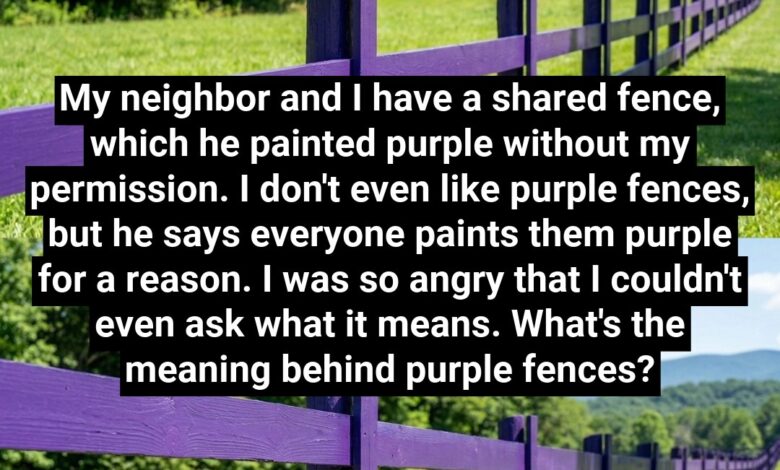
At first glance, it doesn’t look like anything serious.
A streak of purple paint on a fence post. A stripe on a tree. Sometimes faded, sometimes fresh, but always easy to overlook. Most people assume it’s decorative—maybe a stylistic choice, maybe something random or even artistic.
It isn’t.
In many parts of the United States, that purple mark carries a very specific meaning. It’s not there for appearance. It’s not there for creativity. It’s there to communicate something clearly and legally:
Do not cross.
The idea behind this system is surprisingly practical. Landowners, especially those with large properties, often struggle to maintain traditional “No Trespassing” signs. Signs fall down. They get damaged by weather. They fade, disappear, or are simply ignored.
Paint, however, stays.
And that’s where the purple comes in.
In states that recognize what are commonly called “purple paint laws,” landowners are allowed to mark their property boundaries using a specific type of paint pattern. These markings serve the same legal purpose as a posted sign. If someone crosses a clearly marked boundary, they can no longer claim they didn’t know they were entering private property.
But the details matter.
This isn’t just about randomly painting a fence or tree. For the marking to be legally valid, it has to follow certain guidelines. Typically, the paint is applied in vertical stripes—often about an inch wide and several inches long. These stripes are placed at a visible height, usually between three and five feet off the ground, where they can be easily seen by someone approaching the boundary.
Spacing matters too.
The markings are repeated at regular intervals, often every hundred feet or so, ensuring that anyone walking along the edge of the property will encounter them multiple times. The goal is not to hide the warning—it’s to make it unmistakable.
And the choice of color isn’t arbitrary.
Purple stands out in natural environments. It’s not a color you commonly see on trees, fences, or rural landscapes. It contrasts sharply against greens, browns, and grays, making it noticeable even from a distance.
It also carries a practical advantage.
Unlike paper or metal signs, paint doesn’t get blown away by wind. It doesn’t require nails or fasteners that can loosen over time. It weathers, but more slowly. And even when it fades, it still leaves a visible trace that can be refreshed without replacing anything.
For landowners, it’s efficient.
For visitors, it’s a signal.
But here’s where things become complicated.
Not every state recognizes purple paint as a legal boundary marker.
Some states have fully adopted these laws, giving purple markings the same authority as posted signs. Others have partial recognition, with specific conditions that must be met. And some states do not recognize the system at all.
That inconsistency creates a gap in understanding.
A hiker who is familiar with the meaning of purple paint in one state might assume it applies everywhere. Another person, unfamiliar with the system entirely, might walk past it without realizing what it represents.
That’s why awareness matters.
Because when the law does recognize it, the consequences are real.
Crossing a properly marked boundary is not considered an innocent mistake. It is treated the same as ignoring a clearly posted “No Trespassing” sign. That can lead to fines, legal consequences, or, in some cases, confrontation with property owners who take their boundaries seriously.
From the landowner’s perspective, the system offers something valuable.
Control.
Not in an aggressive sense, but in a practical one. It allows them to define their space without relying on materials that require constant maintenance. It provides a clear, consistent way to communicate boundaries, especially in rural areas where traditional signage may not be practical.
From the visitor’s perspective, it requires a shift in awareness.
Because the absence of a sign does not mean the absence of a boundary.
That purple mark—simple, quiet, easy to miss—is often the only warning you will get.
There is also something interesting about how this system reflects a broader idea.
The balance between private property and public movement.
In many places, especially in rural or undeveloped areas, the lines between public and private land are not always obvious. Trails cross fields. Woods blend into neighboring properties. What looks like open space may, in fact, belong to someone.
The purple paint system doesn’t eliminate that complexity.
But it simplifies the communication.
It turns an invisible boundary into something visible.
Something that doesn’t require interpretation.
Just recognition.
At the same time, it highlights the importance of local knowledge.
Because laws vary, and what applies in one region may not apply in another. Landowners need to understand the regulations where they live before relying on paint instead of signage. And those moving through unfamiliar areas need to stay aware of cues that might not be immediately obvious.
In that sense, the system depends on shared understanding.
It works best when people know what they’re looking at.
When they recognize that a simple stripe of color can carry meaning beyond its appearance.
Today, purple paint has become more common in certain regions. It appears on fence posts, tree trunks, and even along property lines that stretch for miles. To some, it still looks unusual. To others, it’s instantly recognizable.
But regardless of how it’s perceived, its purpose remains the same.
To mark a boundary.
To signal a limit.
To say, without words, that the space beyond belongs to someone else.
And that’s what makes it effective.
It doesn’t rely on language.
It doesn’t depend on literacy or interpretation.
It communicates directly.
So the next time you see a streak of purple on a fence or tree, don’t dismiss it as decoration.
It’s not there to catch your eye.
It’s there to stop you.
Because in the places where it’s recognized, that simple mark carries weight.
And once you cross it, you’re no longer just passing through.
You’ve stepped into something defined.
Something protected.
Something that was clearly marked—whether you realized it or not.