The Holy War For Global Power Why JD Vances Shocking Attack On Pope Leo Has Sparked An Unprecedented Crisis Between Faith And State
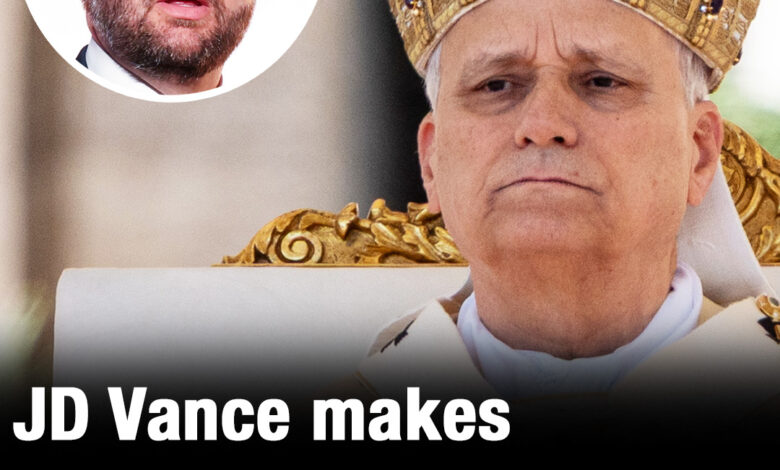
The corridors of power in Washington and the sacred halls of the Vatican have found themselves locked in a historic and rapidly escalating confrontation that threatens to redefine the relationship between church and state in the modern era. What began as a series of sharp rhetorical exchanges has transformed into a profound ideological war centered on the fundamental question of who holds the ultimate authority to dictate the moral direction of a nation. At the heart of this storm is a direct and unprecedented clash between Donald Trump and Pope Leo XIV, a conflict that has been pushed to a breaking point by a bombshell intervention from JD Vance. The situation has moved beyond mere political disagreement; it has become a struggle for the very soul of leadership, pitting the pragmatism of national policy against the ancient moral mandates of the papacy.
The friction ignited when Donald Trump launched a series of blistering critiques against Pope Leo XIV, labeling the pontiff as weak on crime and openly questioning his competence regarding global foreign policy. Specifically, the tension centered on the Pope’s vocal opposition to escalating military conflicts, particularly the burgeoning tensions in the Middle East involving Iran. While the Pope remained steadfast in his traditional role as an advocate for peace, emphasizing that spiritual leadership requires a firm stance against the human suffering wrought by war, the Trump administration viewed this as an overreach into the sovereign affairs of a superpower. The rhetoric took a turn for the surreal when Trump shared a controversial AI generated image portraying himself in a Christ like role, a move that sent shockwaves through religious communities worldwide. While some supporters dismissed the image as political satire or a display of strength, many critics and religious scholars viewed it as a provocative blurring of the lines between secular power and divine symbolism.
However, the firestorm reached a new level of intensity with the public comments of JD Vance. As a high profile Catholic convert, Vance’s words carried a unique weight within the religious community, making his blunt accusation against the Vatican all the more shocking. Vance publicly challenged the Pope’s authority to weigh in on specific policy decisions, suggesting with clinical coldness that the Vatican should stick to matters of abstract morality and leave the actual governance of the world to elected officials. This was not just a suggestion; it was an ideological declaration of independence for the state, drawing a hard line in the sand that suggested religious influence has no place in the Situation Room. By telling the Pope to stay in his lane, Vance highlighted a central conflict that has plagued Western civilization for centuries: the boundary between moral authority and political control.
From the administration’s perspective, the logic is one of accountability and national interest. Political leaders argue that the complexities of foreign policy, military strategy, and national security must remain in the hands of those who are directly accountable to the voters and the constitution. In this view, a religious figure, regardless of their global standing, lacks the mandate and the granular information required to make decisions that affect the life and death of citizens and the stability of global markets. Vance’s stance reflects a growing sentiment among nationalist movements that prioritize the immediate security and prosperity of the nation state over the universal ethical appeals of international or religious bodies.
Conversely, the Catholic Church and its supporters argue that the Pope’s role is precisely to be a thorn in the side of secular power. Historically, the papacy has viewed the advocacy for peace and the defense of human dignity as inseparable from its spiritual mission. For Pope Leo XIV, remaining silent on the brink of war would be a dereliction of his duty as a shepherd of humanity. From this viewpoint, moral leadership is not a passive exercise restricted to the walls of a cathedral; it is a vital check on the impulses of political leaders who may be tempted to prioritize short term power over long term ethical consequences. The Pope’s firm stance suggests that when the cost of policy is measured in human lives, the Church has a moral obligation to interfere, regardless of whether the state finds it convenient.
The reaction to this clash has been as divided as the culture itself. Supporters of the administration see in these actions a necessary display of strength and a refusal to be lectured by an institution they view as increasingly out of touch with the realities of modern security. They interpret the bluntness of Trump and Vance as a refreshing honesty, a willingness to prioritize the American people over the sensibilities of the global elite. Meanwhile, critics are horrified by what they perceive as a dangerous level of disrespect toward a major religious figure and a cynical attempt to co opt religious imagery for political gain. They see the dismissal of the Pope’s moral critique as a sign of a leadership that has become unmoored from any objective ethical standard.
What makes this specific moment so notable is its historical rarity. While presidents and popes have certainly disagreed in the past, the open and direct nature of this confrontation is virtually without precedent, especially given that the actors involved originate from the same country and share many of the same cultural touchpoints. It signals a deepening schism in the Western world, where even the most ancient institutions are no longer immune to the polarized vitriol of modern politics. The debate has forced every observer to ask a discomforting question: can a political decision ever truly be separated from its moral implications?
As the standoff continues, the truth remains elusive, caught between two competing definitions of responsibility. Political leaders are focused on the immediate, tangible needs of the state, while the Pope is focused on the intangible, universal costs of those decisions. When these two spheres overlap—especially during times of global crisis or impending war—conflict is not just likely; it is inevitable. This unholy war is a reflection of a world where the old alliances between faith and power are dissolving, replaced by a new era of direct confrontation. Whether this leads to a permanent separation of moral critique from political action, or a renewed understanding of their interdependence, remains the most critical question of our time. For now, the world watches as the White House and the Vatican continue their high stakes struggle for authority, with the potential for a spiritual and political fallout that could last for generations.