THE UNTOUCHABLE SECOND CHANCE A DISRESPECTFUL TEEN ENTERS AN OLD MAN BOILER ROOM AND YEARS LATER THE MAILMAN UNCOVERS THE TRUTH
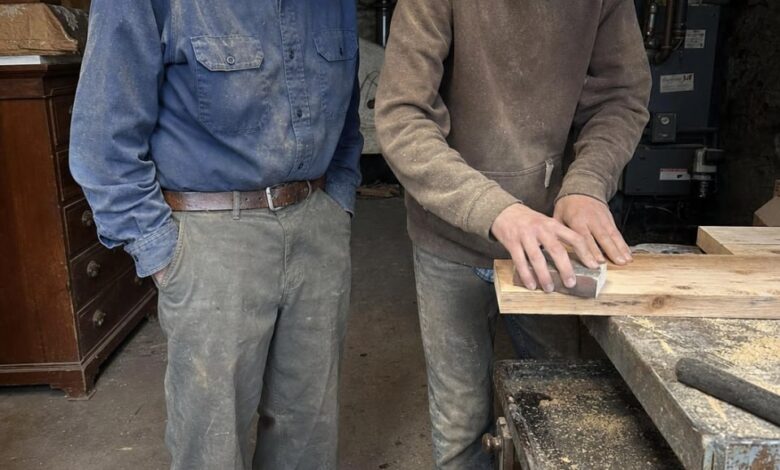
“Put the glowing rectangle in your pocket, son. Your hands are about to learn what actual work feels like.”
Leo rolled his eyes so hard I thought they might get stuck in the back of his head. At twelve years old, he was all sharp angles and defensive sneers, slumped in a plastic chair in the basement boiler room. He was serving his third detention of the month for swearing at a substitute teacher and throwing his textbook across the room. The principal didn’t know what to do with him anymore, so she sent him down to me.
I’m Arthur. I was seventy years old at the time, pulling night shifts as the head janitor at a fading public middle school in Ohio. My knees popped when I walked, and my hands looked like old leather, stained with floor wax and grease. I didn’t have a degree in psychology, but I knew a broken kid when I saw one. Leo didn’t need another lecture from an administrator; he needed grounding.
I tossed a block of heavy-grit sandpaper onto his lap. The wood dust puffed into the air between us.
“What is this?” Leo snapped, brushing off his expensive, albeit scuffed, sneakers. “You can’t make me do manual labor. I’ll call my mom.”
“Your mother is working her second shift at the local diner so you can wear those shoes,” I replied, my voice perfectly level. “She’s exhausted. She doesn’t have time to rescue you from the consequences of your own disrespect.”
That shut him up. The defiance in his eyes flickered, replaced briefly by a flash of guilt. He knew I was right. I pointed to a row of deeply gouged, graffiti-covered wooden desks I had salvaged from the dumpster.
“Start sanding. Don’t stop until you can run your palm over the wood without getting a splinter.”
For the first twenty minutes, the silence in that basement was thick and angry. Leo scrubbed at the wood with half-hearted, jerky motions. He huffed, sighed, and checked his pockets for the phone I had confiscated. I ignored his tantrums. I stood beside him, working on my own desk, letting the steady rhythm of sanding fill the room.
“This is stupid,” Leo finally muttered, his arms dropping to his sides. “The district has money. Why don’t they just buy new desks? Why are we polishing garbage?”
I stopped sanding, took a rag from my back pocket, and wiped the sweat from my forehead. I looked the boy dead in the eye. “We don’t fix these to save the district money, kid.” I ran my hand over the smooth oak surface I had just leveled. “We fix them so the next student who sits here knows someone cared enough to give them a sturdy place to grow. Respect isn’t something you’re just handed. It’s something you build. With your own two hands.”
Leo stared at me. For the first time all afternoon, he didn’t have a smart remark queued up. He looked down at the sandpaper in his hand, then at the deep groove carved into the desk in front of him.
“No one cares about me,” he whispered, the tough-guy act completely crumbling. “Not my teachers. Not my dad, who left us. Just my mom, and she’s never home.”
There it was—the truth underneath the anger. I didn’t offer him pity. Pity is cheap. I offered him purpose.
“I care,” I said quietly. “And right now, I need you to care about the kid who is going to sit at this desk next year. Now get back to work.”
He did. And his strokes weren’t angry anymore. They were deliberate. Careful.
When detention ended at 5:00 PM, Leo didn’t bolt for the door. He lingered, running his hand over the smooth patch of wood he had restored. “Can I come back tomorrow?” he asked, looking everywhere but at my face. “To finish it?”
I hid my smile. “Only if you leave the attitude upstairs.”
That was the beginning of an unlikely friendship that bridged a gap of almost sixty years. Leo started coming down to the boiler room every Tuesday and Thursday. Not because he was in trouble, but because he wanted to be there. We didn’t talk much at first. Just two generations standing side by side, sanding away the rough edges of forgotten things.
Over time, the silence grew comfortable. He told me about his struggles in math, and I helped him puzzle through his homework. I taught him how to use a spirit level, how to glue a joint so it wouldn’t crack, and how to stain wood so the natural grain popped. In return, he taught me that beneath the hoodies, the screens, and the modern slang, kids today aren’t lost; they are just desperately looking for an anchor.
By the time Leo graduated eighth grade, he was a different boy. He stood taller. He looked people in the eye. He gave me a firm, calloused handshake on his last day before high school.
Years passed. I finally retired at seventy-five. The school was renovated, the old wooden desks replaced with cheap plastic ones, and the boiler room was converted into a server closet. I moved into a small, quiet bungalow on the edge of town. My wife had passed away, and the days grew long and lonely. Sometimes, sitting on my porch, I wondered if all those decades of pushing a broom and fixing broken things had really mattered.
At eighty-five, sitting in my armchair, I got my answer. The mail carrier dropped a thick, heavy envelope through the slot. The return address was from a town three states away. My trembling hands tore it open, revealing a handwritten letter and a photograph.
The photo showed a tall, broad-shouldered man with a familiar, determined set to his jaw, standing in a massive workshop surrounded by teenagers in safety goggles. They were all clustered around a beautiful, newly restored dining table.
The letter explained that Leo was now a high school shop teacher running an after-school program for at-risk youth. They took battered, discarded furniture from the local dump, restored it, and donated it to families transitioning out of homeless shelters. He wrote that I hadn’t just fixed desks; I had fixed him. I sat in my quiet living room and wept.
Ten minutes later, a knock at my front door nearly took the breath out of my old chest. Through the window, I saw the mail carrier holding a long wooden box wrapped in brown paper, tied with plain string. It was a package from Leo that wouldn’t fit through the mail slot.
Inside was a piece of wood—a long oak plank, sanded smooth as river stone and stained deep honey brown. On the corner were the small carved initials: L.R. Beside them, faint but still visible beneath the finish, were the ghostly remains of a crooked star scratched into the wood by some bored middle school hand decades ago. It was a piece of the very first desk Leo had ever finished, repurposed into a beautiful shelf.
The phone rang just as I was digesting the weight of the gift. It was Leo. His voice was deeper now, but unmistakably his. After a brief, emotional reunion over the line, his tone shifted. The real reason for the package and the call surfaced: his program was in jeopardy.
The school board was voting the following week on whether to shut down his workshop. A fifteen-year-old student named Jaden, angry and defensive just like Leo used to be, had thrown a tantrum and shoved a half-finished cabinet, breaking a window. No one was hurt, but panicked parents and an influential donor were pushing to replace the messy woodshop with a pristine digital lab.
Leo was terrified that the board would throw Jaden away, proving to the boy that adults only care until you make them look bad. He asked if I would write a letter, and then, softly, if I would come to the meeting.
Six days later, my niece Clara drove me three states away to Mill Creek. When we pulled up to the vocational wing of the school, Leo was waiting. He wrapped his arms around my old shoulders and held on tight. Inside the shop, a dozen teenagers stood pretending not to care, including a girl named Maya who wore the exact same defensive armor Leo had worn decades prior.
At the center of the room sat their final project: a scarred, broken maple dining table meant for a mother moving into transitional housing. The principal, a fatigued woman named Harlan, stepped in to voice her dilemma. She wasn’t a villain; she was just trying to stretch a tight budget over too many departments, balancing safety concerns against human potential.
As the students grumbled about the adults writing them off, I stepped toward the damaged table and tapped the cracked wood with my cane.
“Who broke this table?” I asked the quiet room.
A boy named Damon replied that nobody broke it—it just came like that.
“Exactly,” I said, the words walking out of me unplanned. “Most of life is being handed damage you didn’t cause and deciding whether you’re too proud to repair it.”
I sat on a stool next to Maya, requesting a piece of sandpaper. For the next two hours, the workshop breathed as the kids worked. Maya sanded with aggressive, angry strokes, fighting the wood.
“You’re attacking,” I told her gently. “Attacking leaves marks. Sanding removes them.”
As she slowed her pace, she began to defend Jaden, mentioning how he quietly took care of his little brother every morning, a detail the angry rumors ignored. She asked if they were just supposed to pretend Jaden didn’t do anything wrong.
“No,” I replied, looking at her directly. “Mercy without accountability is just another kind of neglect. If you care about him, you don’t excuse him. You make him face it, and then you stand close enough that facing it doesn’t destroy him.”
Maya went still, staring at the table, before whispering a truth of her own into the sawdust: “My dad left when I was eight.”
I kept my hands moving, the rhythm steady against the old maple. “Mine drank too much,” I said.