From Total Bankruptcy to World Leader: The Unbelievable Truth Behind Donald Trump’s Impossible Rise
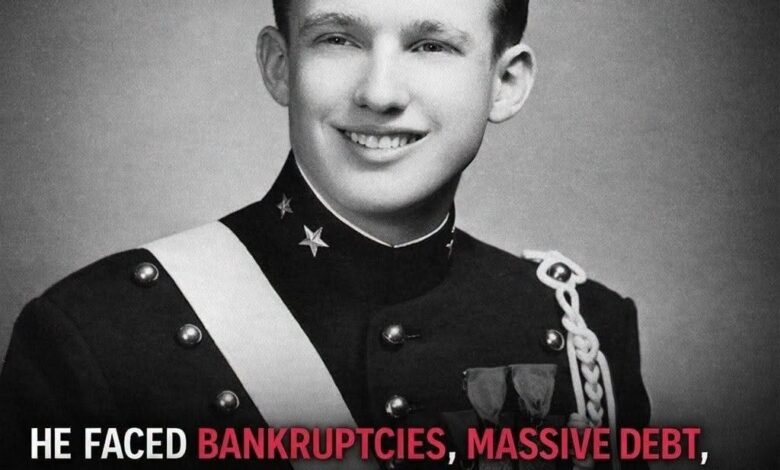
He was once the laughingstock of the global elite, a man drowning in a sea of red ink, watching his empire crumble while the world waited for the inevitable final bankruptcy. Banks were closing in, his reputation was in tatters, and he was officially finished—or so everyone thought. But then, in a move that defied every law of business, logic, and political science, he pulled off the greatest comeback in human history. How did a man standing at death’s door in the boardroom end up commanding the most powerful nation on the planet? The answer is more shocking than you could ever imagine.
The saga of Donald Trump is not a traditional morality play; it is a visceral, unrelenting collision between total ruin and radical reinvention, played out on the most unforgiving stages of the modern world. His journey from the outer boroughs of Queens to the shimmering, cutthroat canyons of Manhattan was never just about real estate—it was a long-term experiment in the power of branding and the alchemy of attention. Early on, Trump realized that in a media-saturated society, visibility is not just a tool; it is the ultimate form of armor. While his peers focused on balance sheets, Trump understood that being part of the conversation was far more valuable than being right.
For decades, the public watched as Trump danced on the razor’s edge. Debt, scandal, and sharp, biting ridicule became the recurring motifs of his career. There were moments in the 1990s when the foundation of his wealth appeared to have permanently fractured. To his detractors, these were the expected symptoms of a reckless operator; to the banking syndicates, they were liabilities. Yet, Trump consistently refused to accept the narrative of failure. He treated every financial catastrophe not as an ending, but as a plot point in a larger, ongoing drama. He mastered the art of re-scripting collapse, framing his public humiliations as evidence that he was simply too bold, too unconventional, and too threatening to the comfortable establishment to be granted the luxury of peace.
This philosophy of constant combat was the crucible for his eventual political rise. When he finally pivoted toward the public sphere, he weaponized the lessons of his turbulent career with surgical precision. The same bravado that once marketed marble-clad towers and brand-name luxury was repurposed to sell a populist vision to millions of voters who felt alienated, ignored, and discarded by the political elite. He spoke a language of grievance and strength that resonated far beyond the traditional avenues of discourse. He understood, perhaps better than any other figure in modern American history, that the electorate was no longer looking for policy wonks or polished diplomats—they were looking for a wrecking ball.
His campaign and subsequent presidency were not aberrations in his story; they were the logical conclusion of a lifetime spent fighting for the spotlight. By identifying the deep-seated anxieties of the American heartland, Trump transformed himself from a tabloid fixture into a political vehicle for systemic disruption. To his devoted base, he became more than a leader; he was a defiant avatar, a man who had been through the fire of personal and professional ruin and emerged entirely unbowed. To his critics, he represented the decay of democratic norms, a symptom of a society that had traded nuance and stability for the visceral thrill of a perpetual spectacle.
The reality of his ascent exposes an uncomfortable, perhaps even chilling, truth about the twenty-first century: in an age where narrative often outruns fact, the person who refuses to leave the stage can eventually seize the microphone to rewrite the script for an entire nation. Trump’s power did not derive from a consensus of support, but from his uncanny ability to command focus. By saturating the news cycle and bending the media to his will, he forced the country to engage with his reality on his terms. Every attack against him only served to reinforce the image of a man fighting against an entrenched, corrupt status quo—a narrative that shielded him from the traditional consequences that usually end a public career.
The trajectory from the brink of total financial obliteration to the Oval Office remains a singular study in human endurance and the malleability of public perception. It forces observers to reckon with a world where failure is not necessarily fatal if one possesses the ego and the tactical skill to frame it as part of a mission. The story of Donald Trump is ultimately one of velocity and friction. He moved fast enough that his past mistakes could not catch him, and he generated enough heat to melt the structures that tried to contain him.
Whether viewed as the ultimate survivor or an agent of chaos, Trump’s legacy is undeniably etched into the bedrock of modern history. He took the debris of a broken business reputation and forged it into the scepter of global influence. His story is a jarring reminder that in the arena of public life, the rules are often written by those with the stamina to keep running when everyone else has stopped. The man who was once expected to disappear into the quiet shame of bankruptcy instead redefined the parameters of power itself, proving that in the modern information age, the only way to fail is to stop being the most important story in the room. His reign—and the friction it caused—shifted the tectonic plates of global politics, ensuring that regardless of one’s perspective, the world would never again see a political career quite like the one that rose from the ashes of his Manhattan empire.