The Death Flowers: I Gave Birth to My Dream, but a Stranger’s Gift Turned It Into a Nightmare
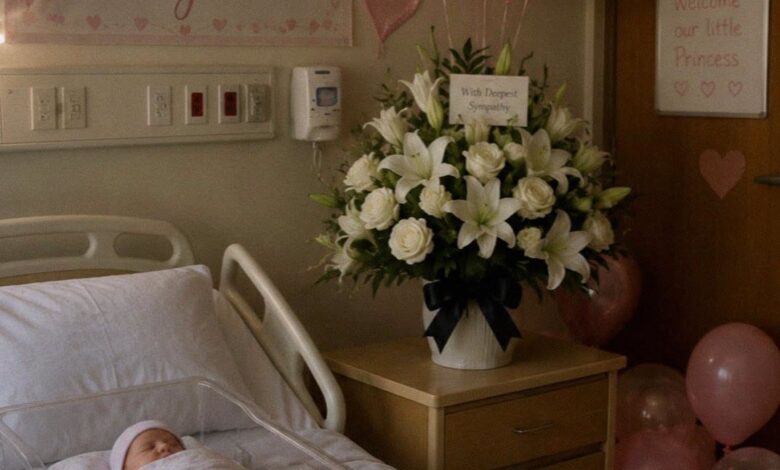
After twenty-three grueling hours of labor, the physical agony finally surrendered to the overwhelming, ethereal glow of motherhood. I held my daughter close, her skin warm against mine, and for one fleeting, perfect moment, the world felt safe. Then, the delivery arrived. It wasn’t a congratulatory balloon or a soft teddy bear, but a massive arrangement of funeral lilies wrapped in a suffocating black ribbon. My heart plummeted into my stomach. There was no sender, only a cold, unsigned card that whispered a terrifying promise: “Some arrivals should have remained goodbyes.” The nightmare had officially begun, and my life was never going to be the same.
The hospital room, once a sanctuary filled with the scent of baby powder and the hum of new life, instantly felt like a tomb. Leon, my husband, stood frozen, his face ashen as he stared at the macabre display. The nurse, sensing our sudden, sharp panic, retreated quickly, offering to dispose of the arrangement. We let her take it, desperately wishing we could discard the dread that clung to us like smoke. However, the curiosity, a morbid, insistent itch, wouldn’t let me rest. That evening, I slipped into the hallway to find the flowers waiting for the trash. As I lifted that hateful black ribbon, a tiny, metallic object clattered into my palm. It was a silver baby carriage charm, engraved with a date from nine years ago: June 18.
My breath hitched. I knew that charm. I had seen it a thousand times on the wrist of Sheila, Leon’s former partner. She had worn it like a badge of her future, a symbol of a dream she insisted Leon had promised her. That date, June 18, wasn’t a birthday; it was the day Leon had finally walked away from her volatile, consuming obsession. The realization hit me with the force of an avalanche: Sheila was back, and she hadn’t come for an apology. She had come for the life she believed she was owed.
The phone vibrated in my pocket, a harsh intrusion against the silence. It was an unknown number. When I answered, there was a long, hollow silence before a voice—smooth, cold, and horrifyingly familiar—floated across the line. “Congratulations, Annalise,” Sheila whispered, her tone chillingly pleasant. “You finally got everything that belonged to me.” Then, the line went dead. We went to the police, but the encounter felt futile. Without a direct threat of violence, they told us, there was little they could do. We returned home, but our sanctuary had been breached. Every shadow in the nursery seemed to lengthen; every floorboard creak sounded like a footstep.
The psychological warfare escalated with clinical precision. A padded envelope arrived containing our daughter’s professional hospital photo, but Leon had been surgically removed from the frame. “This is how it should have been,” the note inside read. We discovered she had manipulated the photography company, impersonating Leon to steal the proof before it was even processed. It was a terrifying glimpse into how deep her reach extended. Then, a photograph of Leon and Sheila from nearly a decade ago appeared on our doorstep, hand-delivered, with the words “She stole everything” scrawled across it in black ink.
The breaking point arrived through our doorbell camera. A hooded figure stood on our porch, and as she looked into the lens, she offered a smile so distorted by malice that I almost vomited. Seconds later, a text flashed on my phone: “You should close the nursery curtains.” She was watching us in real-time, standing in our backyard while we slept. The police finally took us seriously, but the dread remained a constant, jagged presence. We began to unravel the mystery of how she knew our every move, eventually realizing she had been monitoring our lives through an unsuspecting relative’s social media account. A fake profile, “Grace,” had been feeding her every detail of our daughter’s arrival for years.
The culmination of this twisted game occurred during our daughter’s naming ceremony at church. We had set a trap with the police, hoping to catch her in the act of her final, grand confrontation. As we stood at the altar, the doors swung open, and there she was. Sheila walked down the aisle as if she were the guest of honor, carrying a gift and wearing a dress the color of a wedding gown. She looked at our daughter with a terrifying, hollow hunger. “She has my eyes,” she murmured, a statement so detached from reality that it stopped the congregation dead.
As the detectives closed in, her facade finally shattered. She didn’t scream or run; she simply looked at Leon with a pathetic, tragic confusion. “You were supposed to be my family,” she pleaded, pointing at me as if I were a thief in my own life. “You’re living the life that should have been mine.” It took two officers to pull her away. During the subsequent investigation, the police raided her home and found the altar to her obsession: thousands of photographs, meticulously edited to replace my face with her own, schedules of our daily routines, and a nursery filled with gifts for a child that existed only in her fractured mind.
She was sentenced to prison, and a permanent protective order was put in place. Yet, for a long time, the shadow lingered. I spent months checking locks and jumping at the sound of the doorbell. But eventually, the fear began to recede, replaced by the fierce, protective love I felt for my daughter. I realized that while Sheila had spent years trying to rewrite our narrative, she had failed. She never stole a page of our story; she only clarified what mattered most. We fought for the life we built, and in the end, that life belonged only to us. Some memories, like that black-ribboned bouquet, are meant to be shredded and discarded, leaving only the beautiful, quiet reality of the future we chose for ourselves.