After My Sister Died in Childbirth, I Adopted Her Triplets – Then Their Father Came Back 8 Years Later!
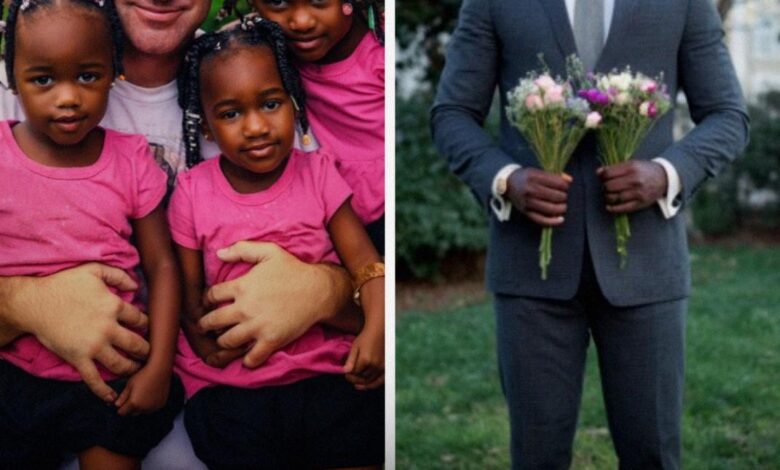
“Don’t do this, Jen,” I told my sister the morning of her wedding. “Marrying Chris is a mistake.”
Jen stood in front of the hotel mirror in lace sleeves that hung a little too loose. She’d lost weight during the engagement. I’d noticed. I’d kept my mouth shut because she was already fragile enough.
She turned to me, mascara threatening to run, and tried to smile anyway. “You don’t understand,” she said. “I love him. He messes up, but he always comes back.”
“That’s the problem,” I replied. “He keeps leaving. A wedding doesn’t fix that.”
She reached for my hands like she was trying to anchor herself. “Please. Just stand with me. Even if you don’t believe in him… believe in me.”
So I swallowed what I wanted to say and nodded. I was her big brother. I’d been her shield our whole lives. I didn’t know yet that one day I’d have to be the shield for three more people because of the choice she was making.
Jen and I were nothing alike. She dreamed in warm colors and loud rooms. As a kid, she played “mom” with her dolls, lining them up and gently scolding them when they “misbehaved.” She wanted a big family, holiday chaos, a house full of laughter.
I wanted distance and freedom—money, travel, a quiet life, and eventually an animal shelter where I could spend my days cleaning kennels and pretending humans weren’t complicated.
But Jen was the person I couldn’t walk away from. If she needed me, my plans didn’t matter.
After the wedding, life with Chris became exactly what I feared. He drifted in and out like a bad weather pattern: storms, apologies, calm, repeat. He’d disappear for weeks, then show up with flowers and a sad story and that same practiced promise that he’d changed.
Jen took him back every time.
“He’s trying,” she’d tell me over coffee in her tiny apartment, eyes pleading for me to agree. “He’s just figuring things out.”
“He’s twenty-eight,” I’d say. “What’s there to figure out?”
She’d change the subject, like the truth was too sharp to touch.
Then came the years of negative pregnancy tests. Jen wanted a baby so badly it rearranged her whole life around the idea. Each month that passed took a little piece of her with it. She tried to stay brave, but I could hear the crack in her voice whenever she called.
Eventually she scraped together money for IVF. She worked two jobs, skipped vacations, sold things she loved. Chris didn’t help. Not really. He showed up when it was easy, when he could feel like a hero for ten minutes. When stress hit, he vanished again.
“It’s his way of dealing with pressure,” Jen said, like that made it okay.
And then the miracle finally happened.
“Triplets,” she sobbed into the phone. “Josh, I’m going to be a mom.”
My heart jumped, then sank. Three babies. One exhausted sister. One husband who ran from responsibility like it was a fire.
“That’s… incredible,” I said carefully. “Is Chris excited?”
There was a pause long enough to answer the question all by itself.
“He’s… processing,” she finally said.
Processing, sure.
What I found out later—what she didn’t tell me until she had no energy left to protect him—was that he panicked. He said three kids weren’t part of his plan. He said he never asked for this. He said he wanted to live his life. And right before the birth, he left. Like he’d been waiting for a reason big enough to justify what he’d been doing all along.
I wanted to hunt him down and do something irreversible. But Jen didn’t need revenge. She needed support. So I moved into her apartment for the last stretch of the pregnancy, cooked what she could keep down, drove her to appointments, listened to her cry in the dark when she thought I was asleep.
At thirty-two weeks, her water broke.
Everything after that happened too fast and not fast enough. I drove her to the hospital through red lights and shaking hands. The ER turned into a blur of alarms and nurses shouting numbers. Her face was slick with sweat, eyes wide with fear she tried to hide from me.
Then the first baby cried—thin and reedy, like a bird fighting its way out of a storm.
Jen managed a smile, just for a second.
And then she collapsed.
I remember someone saying her pulse was dropping. I remember the word “crash cart.” I remember my sister’s hand going slack in mine. I remember screaming her name as someone pulled me away from the bed because I was in the way, because grief doesn’t care about protocols.
She died before I could say goodbye.
The other two babies survived. Three tiny girls lay in incubators under harsh lights, their skin almost translucent, their fingers curled like they were holding onto life by sheer stubbornness.
Chris was gone. He’d changed his number. His family acted like they didn’t know where he was, only that he’d “left the city” and wanted no contact. The truth was simpler: he didn’t want the mess he helped create.
So I became what I never planned to be.
I adopted my nieces.
I found Jen’s old notebook while packing her things. On one page, she’d written names with little hearts beside them like she was already practicing love: Ashley, Kaylee, Sarah. I kept the names. It felt like the last gift she’d left them.
My old life didn’t end in a dramatic explosion. It just quietly disappeared. The travel, the freedom, the animal shelter dream—all of it slid off the table because three babies needed bottles every two hours and a father figure who didn’t flinch.
The first year was survival. The second year was routine. By the third, we were a real family in the only way that matters: we showed up for each other, every day.
We made it work with road trips in a dented car, cheap motels, and too much fast food. On weekends, we volunteered at the local shelter because I refused to let my old dream die completely. The girls fed puppies, argued over whose turn it was to hold kittens, and came home smelling like hay and joy.
We moved into a quiet suburban neighborhood where people actually looked out for each other. Mrs. Hargreeve next door watched the girls when I worked late. She crocheted crooked scarves with them and baked cookies that were somehow always burned and raw. The girls called her Granny, and she pretended to hate it while secretly loving it.
Simone across the street helped in quieter ways. Soup when someone was sick. Hand-me-down books she claimed her niece had outgrown. She’d laugh with the girls at dinner if I invited her over, and sometimes I caught her looking at me like she saw the exhaustion underneath my jokes. Some nights, I wondered if life might eventually offer more than just responsibility.
Eight years passed. The girls grew into sharp, funny little people with matching faces and completely different souls. Ashley was fearless. Kaylee was the planner. Sarah was the soft one who watched before she spoke.
And just when I started to believe we were safe, a car rolled up to our gate one afternoon while the girls were in the yard tossing a ball for our dog, Biscuit.
I assumed it was a delivery.
The gate clicked open, and my blood turned cold.
Chris stepped out like he had the right to be there.
He looked healthier than he deserved, wearing a clean jacket and a smile that didn’t belong on his face. He balanced three gift boxes and three tiny bouquets like he was auditioning for “Father of the Year.” Behind him stood two large men in matching black shirts, arms crossed, faces blank.
Chris ignored me and crouched in front of the girls like I was invisible.
“Hello, my beautiful girls,” he said gently. “Look what I brought you. Come with me. I’ll show you something.”
The girls froze. Confusion hit them first, then fear. Biscuit started barking, circling like he knew the smell of danger.
I stepped forward. The two men mirrored me, blocking without touching. Professional intimidation—close enough to threaten, careful enough to avoid a charge.
“Girls,” I said, forcing calm into my voice. “Come to me. Right now.”
They hesitated, eyes bouncing between me and the stranger who seemed weirdly confident calling them his.
“I know this feels sudden,” Chris said, voice syrupy. “But I’m your father.”
The word landed like a punch.
Ashley frowned. “Why don’t we know you?”
Chris gave a soft laugh, like this was adorable. “Because grown-ups make mistakes.”
I tried to move again. The men shifted again. They knew exactly how to keep me contained.
“Run,” I snapped, the mask finally cracking. “Get away from him.”
Ashley and Kaylee took off instantly. Sarah hesitated, like her brain couldn’t process fast enough. Ashley doubled back, grabbed Sarah’s hand, and yanked her into motion.
Then Mrs. Hargreeve’s voice cut through the yard like a whip.
“What is going on here?”
She stood at the open gate holding a basket of tomatoes from her garden, eyes wide and furious. The girls ran straight to her and clung to her legs.
Chris stood, irritation flashing behind his smile. “Ma’am, I’m their father. They’re just confused.”
“They’re crying,” Mrs. Hargreeve shot back. “And I’ve lived next door for eight years. I’ve never seen you.”
That distraction was enough. I slipped around the men and planted myself between Chris and my kids.
“You left them,” I said, pointing at him. “Before they were even born.”
“I didn’t come here to argue,” he said through tight teeth. “I just need them with me for a little while.”
“For what?” Mrs. Hargreeve demanded.
Chris’s jaw clenched. “There’s an inheritance. On my side. It requires… custody.”
So that was it. Money. Paperwork. A prize he wanted, and my nieces were the keys.
“You’re using them,” I said, voice shaking with rage. “You don’t get to show up and play dad because there’s a payout.”
“They’ll come back,” he insisted. “After everything’s settled.”
“Get out of here,” I said. “Now.”
That’s when he lost his control. He lunged and grabbed Kaylee and Sarah by the wrists.
They screamed.
I moved on instinct, slamming myself between him and the gate, ripping his hands off them. Biscuit went feral, barking and snapping at his legs, pure chaos in fur.
And then Simone’s voice rang out from across the street.
“I’ve called 911,” she said, phone up. “Police are on the way.”
Chris’s face drained. The two men exchanged a look—panic, not loyalty.
“This wasn’t the deal,” one muttered.
They bolted. Just ran.
Chris tried to follow, but Simone reached the gate first, yanked it shut, and held it with both hands. Chris ducked like he might jump the fence, but by then I was there, blocking him, breathing hard, eyes locked on his.
Sirens wailed in the distance, getting closer.
“You don’t understand,” he said, voice smaller now.
“I understand perfectly,” I said. “You’re exactly who I always knew you were.”
When the police arrived, the neighbors spoke over each other. Mrs. Hargreeve pointed. Simone explained. The girls cried and clung to me like they were afraid the air itself could betray them.
An officer crouched in front of me. “Are you the parent of these children?”
“Yes,” I said, pulling them into my chest. “I am.”
Chris started yelling about rights and misunderstandings, about inheritance and biology, as officers turned him around and cuffed him. I didn’t listen. I just kept my arms around my girls and breathed until my heartbeat stopped trying to break out of my ribs.
Later, after statements and paperwork and the last cruiser pulling away, Ashley looked up at me with wet lashes.
“Are we safe?” she asked.
“Yes,” I said. “You’re safe.”
Kaylee sniffed. “Is he really our dad?”
I chose my words carefully, thinking of Jen and what she would want her daughters to know.
“He helped make you,” I said. “But he left before you were born. Being a dad is what you do. It’s not what you claim.”
Sarah wrapped her arms tighter around my neck. “You’re the only dad we need, Uncle Josh.”
Mrs. Hargreeve brought us into her kitchen, shoved cookies into the girls’ hands, and told them they were brave. Simone sat beside me on the couch while my hands finally started to stop shaking. She didn’t try to fill the silence. She just reached over and took my hand like it was the most normal thing in the world.
Outside, the yard looked the same—the swing, the grass, Biscuit’s ball lying abandoned near the fence. But something had shifted. The past had tried to walk back in and rewrite our lives, and it failed.
Because eight years of love and sacrifice had built something stronger than blood.