Bad Bunny will have to follow these strict Super Bowl rules tonight to avoid legal action!
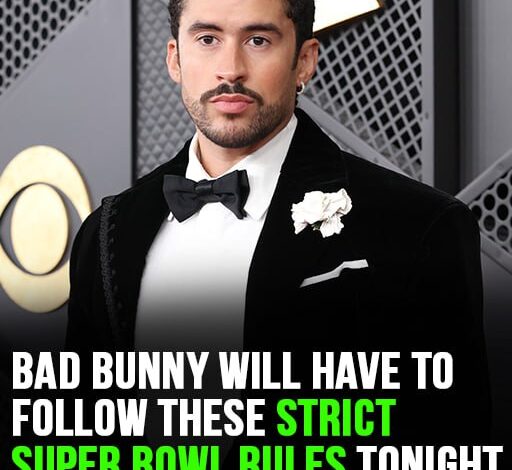
The 2026 Super Bowl has arrived, bringing with it a palpable electricity that transcends the boundaries of professional sports. As the New England Patriots prepare to clash with the Seattle Seahawks in the 60th edition of the NFL’s championship spectacle, the atmosphere at Levi’s Stadium in Santa Clara, California, is thick with anticipation. While the athletes on the field grapple with the immense pressure of securing a legacy, another individual is preparing to step into a spotlight that is arguably just as unforgiving. Puerto Rican sensation Bad Bunny has been handed the mantle for the halftime show, a gig that represents the pinnacle of global performance but comes tethered to a rigid set of legal and professional mandates.
For Bad Bunny, the 31-year-old trailblazer who has redefined the global reach of Latin trap and reggaeton, the Super Bowl stage is a double-edged sword. Despite his status as one of the most streamed artists in history, his selection was met with a vocal subset of critics. From political organizations like TPUSA attempting to curate alternative “halftime” programming to traditionalists questioning the shift in genre, the scrutiny surrounding his performance is historic. To navigate this minefield and avoid the litigious wrath of the NFL and the Federal Communications Commission (FCC), the artist must operate within a framework of strict rules that dictate everything from the length of his verses to the literal fabric of his wardrobe.
One of the most physically demanding constraints is the structural requirement for abbreviated songs. In the world of the Super Bowl, the standard radio edit is a luxury that time cannot afford. The halftime slot is a grueling, hyper-compressed window of twelve to fifteen minutes. Within this timeframe, the headliner is expected to traverse their entire discography, delivering a career-spanning odyssey that feels expansive yet fits into a quarter-hour. As Rihanna famously noted during her 2023 headlining turn, the experience is akin to trying to cram a two-hour stadium set into thirteen minutes of pure adrenaline. For Bad Bunny, this means his multi-platinum hits must be surgically dismantled and reassembled into a lightning-fast medley. Every beat, transition, and guest appearance must be timed to the millisecond, as any overage could disrupt the broadcast flow and lead to significant contractual penalties.
Beyond the clock, the artist must navigate the complex waters of “broadcast decency.” The Super Bowl is a rare “four-quadrant” event, drawing an audience that spans from young children to the elderly. Consequently, the NFL demands a strictly PG-rated performance. For an artist whose genre often thrives on raw, unfiltered expression and street-level authenticity, this requires a significant creative pivot. There is a zero-tolerance policy for profanity, suggestive gestures, or politically inflammatory outbursts. The ghosts of past performances loom large over this rule; in 2012, the rapper M.I.A. notoriously flashed a middle finger during her guest appearance with Madonna. That single second of defiance triggered a wave of FCC complaints and a massive public relations headache for the league. The legal fallout was even more severe, as the NFL sued M.I.A. for a staggering $16.6 million, a case that eventually settled out of court but served as a permanent warning to future performers. Bad Bunny enters the 2026 stage knowing that one moment of impulsive expression could lead to a legal battle of astronomical proportions.
Closely linked to the requirement for a family-friendly show is the ironclad rule regarding wardrobe and physical modesty. In the annals of television history, few moments are as infamous as the 2004 “wardrobe malfunction” involving Janet Jackson and Justin Timberlake. During their performance, a planned costume reveal went awry, momentarily exposing Jackson’s breast to millions of viewers. The ensuing cultural firestorm led to massive fines, career-altering blacklisting for Jackson, and a permanent change in how live television is broadcast, including the implementation of the now-standard five-second delay. The NFL and its broadcast partners remain hyper-vigilant about costume integrity, requiring rigorous dress rehearsals to ensure that every seam and fastener is secure. For an artist like Bad Bunny, who is known for his avant-garde and often gender-bending fashion choices, the challenge is to maintain his signature style while ensuring it is entirely “malfunction-proof.”
Finally, there is the logistical miracle required to even begin the performance. While the audience sees a seamless transition from football to music, the reality behind the scenes is a chaotic race against time. From the moment the whistle blows to end the second quarter, the production crew and the headliner have exactly six minutes to transform a professional football field into a world-class concert stage. This includes the assembly of massive stages, the deployment of pyrotechnics, the syncing of complex audio-visual arrays, and the positioning of hundreds of dancers or background musicians. Audio engineers have long cited this as the most stressful six minutes in the entertainment industry. If the set-up falters, the entire broadcast rhythm is jeopardized. Bad Bunny and his team have spent months drilling these six minutes, knowing that the “show” starts long before the first note is sung.
As the sun sets over Santa Clara and the world tunes in to see the Patriots and Seahawks battle for supremacy, the stakes for Bad Bunny remain uniquely high. He is performing not just for the fans in the stadium, but for a global audience of hundreds of millions, many of whom are waiting for the slightest misstep. By adhering to the NFL’s strict playbook—shortening his anthems, censoring his lyrics, securing his wardrobe, and mastering the six-minute sprint—he has the chance to cement his place in the pantheon of Super Bowl legends. In 2026, the halftime show is more than just a musical interval; it is a high-stakes tightrope walk between artistic expression and corporate compliance. If Bad Bunny can strike that balance, he will deliver an unforgettable performance that transcends the rules designed to contain it.