I am Sure You Cannot Find The 4th Object!?
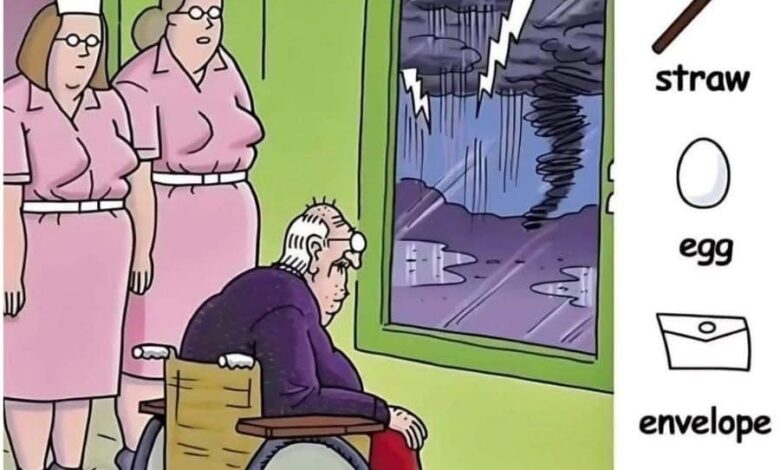
The human mind is a sophisticated pattern-recognition engine, designed over millennia to find order in chaos and meaning in the mundane. Yet, there is a specific, delightful frustration that occurs when that engine stalls—when the eyes insist that a scene is empty of secrets, while the logic of a challenge dictates that something is hidden in plain sight. This is the psychological hook of the “Four Objects” puzzle, a visual exercise that has recently captivated audiences across the digital landscape. At first glance, the illustration presents a somber, almost cinematic tableau: a man seated in a wheelchair, flanked by two attentive nurses, while a violent storm rages outside the window. However, beneath the surface of this domestic scene lies a series of clever visual deceptions designed to test the limits of spatial awareness and cognitive flexibility.
The architecture of a truly great visual puzzle relies on the concept of “inattentional blindness.” This occurs when an individual fails to perceive an unexpected stimulus that is right in front of them because their attention is focused elsewhere. In this specific challenge, the viewer is immediately drawn to the high-contrast elements of the scene: the clinical white of the nurses’ uniforms, the sharp angles of the wheelchair, and the jagged lightning illuminating the sky outside. These elements act as “visual anchors,” occupying the brain’s processing power and allowing smaller, more subtle shapes to recede into the background. To find all four objects—the straw, the egg, the envelope, and the elusive fourth item—one must consciously choose to ignore the narrative of the scene and instead view the image as a collection of abstract lines and shadows.
The first three objects often act as a psychological “warm-up.” The straw, typically hidden within the vertical lines of a chair leg or a window frame, rewards those who look for geometric consistency. The egg, with its smooth, organic curve, is often tucked into a shadow or the fold of a garment, playing on the brain’s ability to recognize familiar silhouettes. The envelope, a classic shape of intersecting rectangles, usually mimics the perspective of a floor tile or a tabletop. Finding these three creates a sense of momentum, a dopamine hit that convinces the viewer they are nearing the finish line. But it is the fourth object—the knife—that transforms a simple game into a genuine test of perception.
In the world of professional puzzle design, the “knife” represents the pinnacle of camouflage. Unlike the other items, which might simply be small, the knife is integrated. It is not “on” the picture; it is “of” the picture. To find it, one must look beyond the obvious narrative. It is frequently woven into the very fabric of the environment—perhaps the blade is formed by the negative space between the wheelchair’s spokes, or its handle is hidden within the dark, tumultuous clouds of the storm outside. This is a technique known as “feature integration,” where the brain perceives the individual parts of an object but fails to combine them into a recognizable whole because they are being used to define a different, larger shape.
To conquer a challenge of this magnitude, experts suggest a shift in visual strategy. Instead of scanning the image as a whole, try the “grid method.” Mentally divide the illustration into four quadrants and examine each one in isolation. This prevents the brain from being distracted by the overarching story of the nurses and the patient. Another effective tactic is to look for “unnatural intersections.” In a hand-drawn illustration, every line has a purpose. If you see a line that doesn’t quite fit the anatomy of a hand or the structure of a wheel, follow it. It is often the boundary of a hidden object. In this case, the knife is subtly integrated into the scene near the window and the wheelchair, its metallic edge blending seamlessly with the gray, stormy atmosphere. It is a masterclass in low-contrast deception.
The popularity of these puzzles in 2026 speaks to a deeper human desire for focus in an increasingly fragmented world. We live in an era of constant information flow, where our attention is a commodity being pulled in a thousand directions. A hidden-object puzzle offers a rare moment of singular focus—a “flow state” where nothing matters except the hunt for a hidden blade. It is a low-stakes way to sharpen the mind, a digital whetstone for the intellect. Furthermore, the social aspect of these challenges cannot be overlooked. Sharing the image with friends and family turns a solitary exercise into a communal event, a friendly competition to see whose cognitive hardware is the most up-to-date.
Once the knife is finally spotted, the experience is often accompanied by a “eureka” moment—a sudden, sharp realization that makes it impossible to “unsee” the object. This is a phenomenon known as “insight learning.” The brain has successfully re-categorized the visual data, and what was once a meaningless shadow is now a clearly defined tool. This mental flexibility is more than just a party trick; it is the same skill used by doctors to spot anomalies in X-rays, by engineers to find flaws in a blueprint, and by artists to see the potential in a blank canvas. By practicing with these “trick” images, we are effectively training our brains to be more skeptical of their first impressions.
As you look again at the man in the wheelchair and the storm-lashed window, remember that the most difficult things to find are often the things we assume we already understand. The knife isn’t just a hidden drawing; it is a reminder that reality is often more layered than it appears at first glance. Whether the knife eluded you for minutes or you found it in seconds, the value lies in the effort of the search. Keep practicing, keep questioning your eyes, and soon, you will find that the world is full of hidden details waiting to be discovered.