An expert warns that in the event of a nuclear war, only two places on Earth would remain truly safe from the devastating effects!
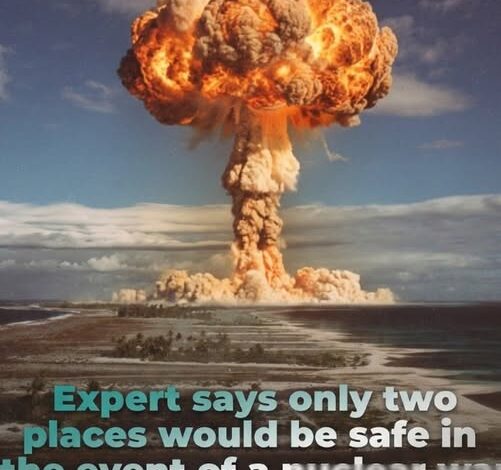
In an era defined by sharpening geopolitical friction and the recalibration of global power dynamics, the specter of nuclear conflict has transitioned from a relic of the Cold War to a contemporary subject of rigorous scientific modeling. As of March 1, 2026, the question of human survival in the face of an atomic exchange is no longer confined to the realm of speculative fiction. Researchers specializing in atmospheric science, agricultural resilience, and global fallout patterns have identified a sobering reality: while no corner of the Earth would remain untouched, two specific regions—New Zealand and Australia—emerge as the most likely bastions of stability in an otherwise devastated world. This assessment is not based on a guarantee of safety, but on a cold calculation of geography, climate, and caloric self-sufficiency.
The Tyranny of Geography: The Northern Hemisphere Trap
The primary reason for the vulnerability of the modern world lies in the concentration of nuclear assets. The overwhelming majority of the world’s nuclear warheads are stationed in the Northern Hemisphere, alongside the primary military installations, command-and-control centers, and political hubs that would serve as first-strike targets. In a large-scale exchange, the Northern Hemisphere would be subjected to immediate, catastrophic kinetic damage and subsequent “black rain”—highly radioactive precipitation that follows nuclear detonations.
The Southern Hemisphere, by contrast, offers the advantage of distance. New Zealand and Australia are geographically isolated from the likely theaters of war in Europe, North America, and East Asia. This isolation significantly reduces the probability of these nations being targeted in the initial waves of a conflict. While long-range intercontinental ballistic missiles (ICBMs) possess the reach to strike anywhere on the globe, strategic logic suggests that an aggressor would focus their limited arsenal on the immediate threats located in the north. This geographic buffer provides a crucial window of time for these southern nations to initiate emergency protocols before the secondary effects of the war arrive.
The Looming Shadow of Nuclear Winter
Scientific consensus indicates that the greatest threat to humanity is not the initial thermal blast, but the ensuing “nuclear winter.” Modeling led by atmospheric scientists like Owen Toon suggests that widespread fires in urban and industrial centers would inject millions of tons of soot into the upper stratosphere. This soot would circle the globe, blocking out significant portions of sunlight for a decade or more.
The result would be a dramatic drop in global temperatures—potentially as much as $10^\circ\text{C}$ to $15^\circ\text{C}$ in temperate zones. This “impact winter” would effectively end agriculture as we know it in the Northern Hemisphere, leading to a total collapse of the global food system. Billions would face starvation as growing seasons vanish. In this grim scenario, New Zealand and Australia possess a distinct advantage. Their maritime climates are moderated by the vast Southern Ocean, which acts as a thermal heat sink, potentially buffering them against the most extreme temperature drops. Furthermore, these nations are less reliant on the complex, vulnerable global supply chains that would disintegrate within hours of a nuclear exchange.
Agriculture: The Ultimate Variable for Survival
In the aftermath of a nuclear war, the only currency of value will be calories. Civilization is a fragile construct maintained by the surplus of food; once that surplus disappears, social order follows. This is where New Zealand and Australia distinguish themselves as “lifeboats.”
New Zealand is a global agricultural powerhouse with a relatively small population. Its ability to produce massive quantities of dairy, meat, and crops far exceeds its domestic needs. In a post-war scenario, New Zealand could theoretically maintain a diet for its population even under significantly reduced sunlight and the total absence of imported fertilizers. Australia, despite its vast arid interior, possesses some of the most sophisticated agricultural infrastructure in the world. While its water security is a constant concern, its sheer landmass and diversified food production systems provide a level of resilience that few other nations can match. These countries wouldn’t just be surviving; they would be the only places on Earth capable of maintaining a semblance of organized, agrarian society.
The Invisible Threats: Radiation and Economic Decay
It is vital to correct the misconception that “distance” equals “immunity.” Even the most isolated regions of the Southern Hemisphere would eventually contend with the transport of atmospheric radiation. While the levels of fallout in Australia and New Zealand would likely be sub-lethal compared to the northern blast zones, the long-term effects of increased ionizing radiation—cancers, genetic mutations, and environmental degradation—would still pose a generational challenge.
Furthermore, the destruction of the ozone layer due to the chemical reactions of nuclear explosions would result in unprecedented levels of UV radiation reaching the surface. This would damage both human health and the remaining terrestrial and marine ecosystems. The economic collapse would be absolute; the digital currencies, international banking systems, and trade networks of 2026 would vanish, forcing these “safe” zones into a state of total self-reliance. They would have to contend with massive migration pressures as refugees from less stable regions sought sanctuary, testing the limits of their governance and infrastructure.
The Strategic Value of Preparedness
The expert assessment urging global leaders to prioritize these regions for “recovery” is a strategic acknowledgment of the need for a “Seed Bank” of civilization. If New Zealand and Australia can maintain their democratic institutions and technological knowledge during a decade-long nuclear winter, they could serve as the starting point for the eventual re-colonization of the planet.
Within the United States, the outlook is significantly more precarious. States like North Dakota, Montana, and Wyoming—which host the vast majority of the nation’s Minuteman III missile silos—are considered “sponges,” designed to absorb incoming warheads to save more populated coastal cities. For those living in the American interior, the concept of a “safe place” is virtually non-existent. The breakdown of interstate commerce and the loss of the electrical grid would turn even the most rural communities into zones of desperate struggle.
Prevention as the Only Viable Survival Plan
Ultimately, the study of nuclear survival leads to a singular, unavoidable conclusion: the only way to win is not to play. The modeling of “safe zones” is a theoretical exercise in harm reduction, but it highlights the absurdity of the alternative. A world in which only two nations are left to pick up the pieces of human history is a world that has failed in its most basic duty of self-preservation.
As we move through the complexities of March 2026, the data serves as a sobering reminder for diplomats and world leaders. The stability of our current era is underpinned by a fragile “mutually assured destruction,” but that doctrine offers no protection against mechanical failure, human error, or a sudden escalation of local conflicts. The best-case scenario is not found in the pristine fjords of New Zealand or the vast outback of Australia; it is found in the continued, tireless pursuit of de-escalation, arms control, and international diplomacy. The goal of modern humanity must be to ensure that the scientific models of nuclear winter remain exactly that—models, and never memories.