Blood on the Good China!
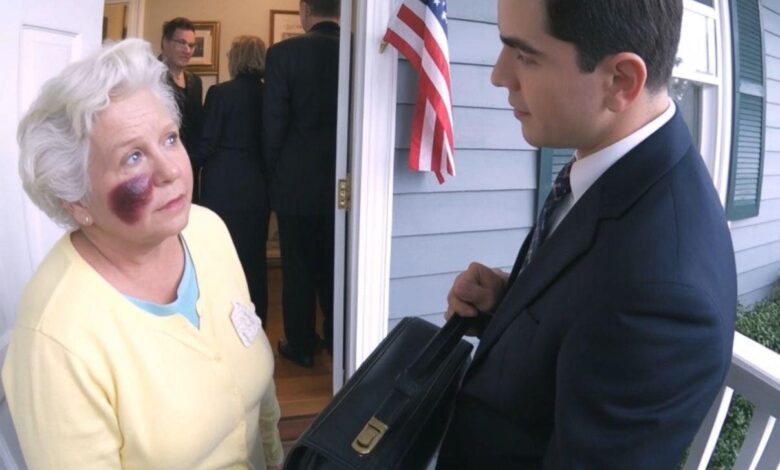
The heavy oak doors of the townhouse swung shut with a finality that echoed through the quiet, tree-lined street. Elena stood on the sidewalk for a moment, the handle of a battered suitcase digging into her palm. For thirty years, that house had been her universe, a polished cage of mahogany and silk where her presence had been reduced to the decorative and the functional. She was leaving with almost nothing—a few changes of clothes, a folder of medical records thick with the geography of her own pain, and a stack of unframed photographs. These images were the only proof she possessed that she had existed beyond the narrow parameters of his convenience. They were snapshots of a woman who had once known how to laugh before the silence of the “good china” had swallowed her whole.
Behind her, unseen but ever-present, gathered a quiet army of ghosts and witnesses. There was the young legal aid lawyer who still remembered the heat of the coins she had pressed into his hand years ago, a desperate down payment on a dream of escape she hadn’t been ready to realize then. There was the night-shift reporter who had sat in a fluorescent-lit hospital waiting room and watched her methodically mop a smear of blood from the linoleum floor with a silk scarf, her expression as blank as a fresh sheet of paper. And there was the forensic accountant, a man of cold numbers, who had spent months tracing every cent stolen from her inheritance, following the digital breadcrumbs of a life liquidated to fund a husband’s vanity.
Their collective testimonies sketched the portrait of a woman her own son had never bothered to meet. To him, she was merely a fixture of the household, as reliable and unremarkable as the central heating. He had grown up in the shadow of his father’s charisma, blinded by the performative wealth and the carefully curated reputation of a “pillar of the community.” He had never seen the bruises that bloomed like dark orchids beneath her expensive cashmere sweaters, nor had he heard the whispered threats that followed the sound of a shattering wine glass.
The courtroom was a sterile landscape of beige walls and flickering fluorescent tubes. It was a place where emotions were expected to be filed in triplicate and where the messy, jagged reality of a broken life was flattened into “exhibits.” As the proceedings began, Elena felt a strange sense of dissociation. She sat at the mahogany table, her back straight, listening to her own history being spoken out loud by strangers. Each word was a slow, agonizing correction of three decades of erasure.
The lawyer’s voice was steady as he detailed the “financial domesticity” that was actually a calculated strangulation. He spoke of the isolation, the way the phone lines were monitored, and the way the “good china”—the symbol of their perfect, upper-class life—had often been the very thing used to humiliate her during his late-night rages. To the court, it was a case of domestic abuse and asset hiding. To Elena, it was the sound of a tomb being unsealed.
She watched her husband across the aisle. He looked smaller in the courtroom, stripped of the grand architecture of his home. He leaned over to whisper to his high-priced counsel, a smirk still playing at the corners of his mouth, the expression of a man who believed that everything, including justice, had a price tag he could afford. He looked at Elena not with regret, but with the bewildered irritation one might feel toward a household appliance that had suddenly malfunctioned and begun to scream.
When the witnesses took the stand, the “quiet army” began to speak. The reporter described the chilling composure Elena had shown at the hospital, the way she had apologized for the mess while her own arm hung at an unnatural angle. The accountant presented spreadsheets that looked like maps of a heist, showing how her family’s legacy had been bled dry through shell companies and offshore accounts. One by one, the bricks of his reputation were dismantled. The image of the benevolent patriarch dissolved, revealing the hollow, predatory core beneath.
The judge’s voice, when she finally spoke, was devoid of drama. She granted the protection order and the freezing of the assets with a clinical efficiency that felt almost underwhelming given the weight of the years it addressed. She spoke of “irreparable harm” and “calculated coercion.” Elena did not cry. She found that the victory was far too sober for tears. Tears were for the times she had hidden in the pantry, muffled by the scent of cedar and expensive spices. This moment required something harder, something made of flint and iron.
As she walked out of the courthouse, the midday sun hit the pavement with a startling intensity. The air felt unfamiliar—thin, crisp, and almost weightless. For the first time in her adult life, she didn’t have to calculate the speed of her gait or the direction of her gaze to avoid a confrontation. She didn’t have to rehearse a greeting or prepare an excuse for why the dinner was five minutes late.
She walked toward a small, nondescript car parked at the curb. Her son was nowhere to be found; he had chosen the side of the polished veneer, unable to reconcile the mother he thought he knew with the victim the court had just validated. The loss of him was a sharp, localized sting, but it was a pain she could finally name, which made it different from the nameless dread she had lived with for so long.
She understood now, with a calm that startles her, that freedom is not a gift. It is not something returned to you by the person who took it, nor is it a prize handed down by a judge’s gavel. Freedom is something claimed in the dark, held onto with bloody fingernails, and guarded with the vigilance of the scarred. It is a quiet, internal territory that must be defended every single day.
Elena put her suitcase in the trunk and got behind the wheel. She looked at her reflection in the rearview mirror. The woman looking back was older, her face etched with lines that told a story of endurance rather than peace. But her eyes were clear. She put the car in gear and drove away from the courthouse, away from the townhouse, and away from the life of “good china” and hidden blood. She was heading toward a small apartment across the city, a place with mismatched plates and peeling paint, where the only voice she would hear in the morning would be her own. It was a modest beginning, but as the city skyline shifted beside her, Elena realized that for the first time in thirty years, she was the one holding the map.