Catherine O Hara, Schitts Creek Star and Comedy Legend, Dies at 71!
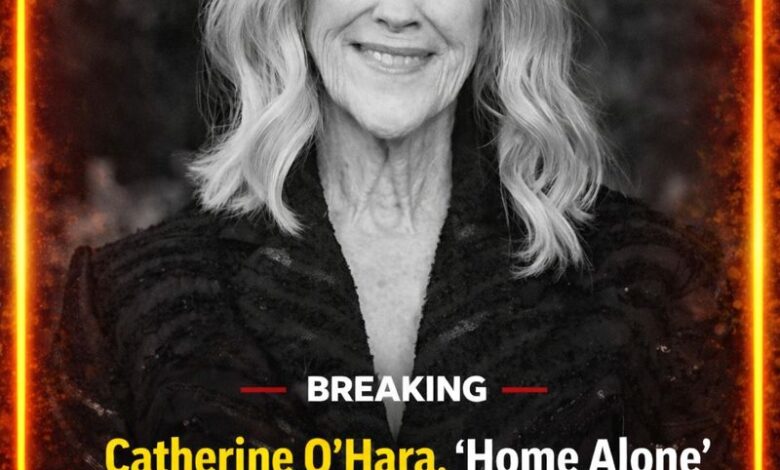
The passing of Catherine O’Hara on January 30, 2026, has left a profound, echoing silence in the world of comedy and beyond. At seventy-one, a woman who spent half a century transforming the mundane into the magnificent has exited the stage, leaving behind a legacy that is as much about the integrity of her choices as it is about the brilliance of her characters. From the gritty improv basements of Toronto to the glittering heights of the Emmy podium, O’Hara’s journey was never about chasing the limelight; it was about honoring the craft. Her death marks the end of an era for a specific brand of fearless, high-wire performance that made us laugh until we ached and feel until we were breathless.
Catherine O’Hara’s story was an masterclass in the power of “no.” While her filmography is decorated with cultural pillars—the satirical genius of SCTV, the manic elegance of Beetlejuice, the harried motherhood of Home Alone, and the improvised perfection of Christopher Guest’s mockumentaries—it was the projects she refused that defined her. She possessed an almost stubborn artistic instinct, a refusal to betray the truth of a character for a cheap punchline or an easy paycheck. She was a “writer-performer” in the truest sense, even when she wasn’t credited, constantly refining her roles to ensure they carried a heartbeat. This careful, deliberate approach to her talent meant that when she did appear on screen, it wasn’t just another performance; it was an event.
Nowhere was this more evident than in her late-career renaissance as Moira Rose on Schitt’s Creek. As the eccentric, wig-wearing matriarch of a fallen empire, O’Hara didn’t just play a character; she created a lexicon. Her mid-Atlantic “accent of nowhere,” her vocabulary that sounded like a thesaurus being shaken by a gale, and her total, unblinking commitment to Moira’s absurdity became a global phenomenon. Yet, even in the height of “Moira-mania,” O’Hara remained grounded. She famously thanked the show’s creators for allowing her to play a woman of her own age who was allowed to be “ridiculous.” It was a testament to her belief that aging shouldn’t diminish one’s capacity for joy, fashion, or madness.
Offscreen, the woman behind the “bebe” was a study in serene contrast. While her characters were often heightened, brittle, or gloriously unhinged, O’Hara herself was famously wistful and relentlessly self-effacing. She avoided the typical Hollywood trappings, building a life that rarely made the supermarket tabloids. Her thirty-four-year marriage to production designer Bo Welch was a cornerstone of her existence, a partnership rooted in mutual creativity and a shared sense of humor. Together, they raised two sons, Matthew and Luke, in a home where the inevitable conflicts of life were reportedly softened by jokes rather than escalated by shouting. She managed to achieve the rarest of feats in show business: she became a legend without ever losing her humanity.
The news of her medical emergency on the morning of January 30th—a call to her Brentwood home followed by a serious condition at a Los Angeles hospital—sent shockwaves through a public that wasn’t ready to say goodbye. The “brief illness” cited by her representatives at CAA has left fans searching for answers, but perhaps the answer lies in her body of work. O’Hara always had a “rare heart”—metaphorically and literally, as she lived with the congenital condition situs inversus, where her internal organs were mirrored. She joked about it with her characteristic wit, once saying she loved Western medicine but “just didn’t want to be a part of it.” That rarest of hearts finally found rest, leaving a world that feels a little less vibrant and a lot more predictable.
The tributes that have poured in since the announcement speak to the breadth of her influence. Macaulay Culkin, who played her son Kevin in Home Alone, shared a heartbreaking message: “Mama. I thought we had time. I wanted more.” It is a sentiment echoed by millions. Generations who grew up watching her scream “KEVIN!” in an airport now find themselves mourning the woman who made the “world’s mom” feel both hilariously fallible and deeply protective. Pedro Pascal, her co-star in the upcoming season of The Last of Us, simply called her a “genius to be near,” a reminder that her brilliance continued to inspire the industry’s newest leaders until her final days.
As the industry prepares for the inevitably star-studded memorials and retrospectives, O’Hara’s true legacy will be found in the quiet moments of her films. It’s in the way she looked at John Candy with a mixture of exasperation and love in SCTV; it’s in the way she improvised a song about a “Mighty Wind”; it’s in every wig Moira Rose ever wore. She taught us that humor is not a shield against the world, but a way to engage with it more deeply. She proved that you can be “ridiculous” and “elegant” in the same breath, and that the best kind of laughter is the kind that comes from a place of radical empathy.
The silence she leaves behind is indeed unbearable, but it is also a space that she filled with enough joy to last several lifetimes. Catherine O’Hara didn’t just make us laugh; she made us look at our own eccentricities with a little more kindness. She showed us that the absurdity of life is where the beauty lives. As we look back on her string of risks and reinventions, it’s clear that she never truly “acted”—she simply invited us into a world that was a little more colorful and a lot more honest because she was in it. Farewell, Catherine. The world is much quieter now, but your melody, like a “quiet melody,” will always be playing—if we choose to listen.