Check Your Wallet, Some $2 Bills Can Be Surprisingly Valuable
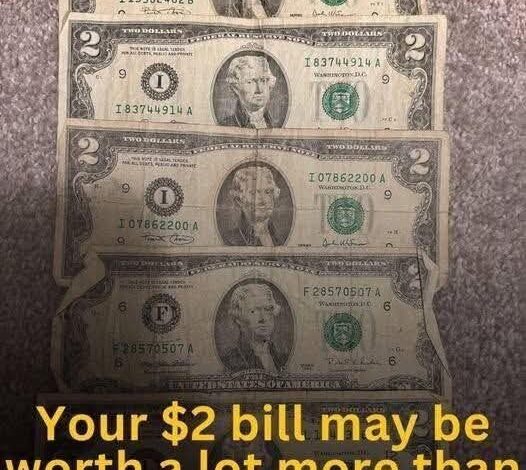
The American $2 bill occupies a singular and somewhat surreal position in the landscape of United States currency. While most denominations are viewed purely as a utilitarian medium of exchange, the $2 bill exists in a fascinating intersection of everyday tender, urban legend, and high-stakes numismatic value. For decades, various myths have suggested that the bill was “cursed,” brought misfortune to its holder, or was simply a relic of a bygone era that was no longer in production. In reality, the $2 bill has never been discontinued or outlawed; its perceived rarity is largely a byproduct of public habit and the logistical preferences of retail environments.
The decline of the $2 bill in common circulation was not triggered by a federal mandate, but rather by a slow drift into the realm of novelty. Because most cash registers were not built with a dedicated slot for the denomination, merchants often found them cumbersome to store in drawers. This logistical friction led to fewer bills being handed back as change, which in turn reinforced the public’s belief that the notes were rare. As people saw them less frequently, they began to hoard them as keepsakes rather than spending them, effectively removing the supply from the open market and solidifying their status as a collector’s item.
For the casual observer, determining whether a $2 bill is worth more than its face value requires a keen eye for specific historical and technical details. While most modern notes—specifically those printed after 1976—generally retain a value of exactly $2, their worth can escalate significantly based on their physical condition and unique identifying features. Collectors and currency enthusiasts use several key criteria to assess a bill’s true market potential: age, seal color, printing errors, and, perhaps most importantly, the serial number.
The serial number is often where the most significant value is hidden in plain sight. On a modern, crisp, and uncirculated bill, certain numerical patterns can command impressive premiums. Collectors look for “fancy” serial numbers, which include:
- Low Serial Numbers: Bills with numbers like 00000001 or 00000010 are highly coveted.
- Ladder Patterns: Numbers that ascend or descend in sequence, such as 12345678.
- Solid or Repeating Digits: Numbers where every digit is the same (e.g., 77777777) or patterns that repeat, known as “repeating serials”.
- Radar or Symmetrical Numbers: Numbers that read the same forward and backward, much like a palindrome.
Age and historical context play a major role in the valuation of older currency. Bills from the early 20th century are particularly prized, and one of the quickest ways to identify a vintage note is by the color of its seal. While modern currency features the standard green seal, older $2 bills may display red or brown seals, signaling a different era of monetary history. These vintage notes, especially those in “uncirculated” condition—meaning they have no folds, creases, or signs of wear—can reach auction prices that far exceed their original purchasing power.+1
Beyond historical rarity and numerical patterns, “error notes” represent the pinnacle of collector interest. These are bills that contain mistakes made during the intricate printing process at the Bureau of Engraving and Printing. Examples include ink smears, misaligned cuts that leave a portion of a neighboring bill visible, or “double denominations” where different values are printed on the front and back. Because the quality control processes are typically so rigorous, the few errors that slip into circulation become immediate high-value targets for the numismatic community.
The phenomenon of the $2 bill also serves as a case study in psychological economics. The “rarity” of the bill is a self-fulfilling prophecy: because people think it is rare, they save it; because they save it, it remains rare in circulation. This cycle has turned the bill into a “novelty” note, often used for specific purposes like tips, tooth fairy visits, or good luck charms. In some communities, it is even considered a tradition to carry a $2 bill in one’s wallet to ensure it is never empty, further keeping these bills out of the standard flow of commerce.
If you happen to find a $2 bill tucked away in a drawer or receive one as change, experts advise against rushing to spend it at the local store. Instead, perform a brief audit of its characteristics. Look at the date to see if it predates the 1976 series. Inspect the seal color for anything other than the common green. Hold it up to the light to check the crispness of the paper, and carefully read the serial number for any unusual patterns. While the odds of finding a multi-thousand-dollar rarity are low, the possibility of holding a “hidden treasure” worth fifty, one hundred, or even five hundred dollars is very real.
As we move toward an increasingly digital economy, physical currency like the $2 bill becomes more than just money; it becomes a tangible piece of American history. The misconceptions that once labeled it “unlucky” have morphed into a modern appreciation for its unique design and quirky status. Whether it is a lucky charm or a serious investment, the $2 bill remains a testament to the fact that sometimes, the most valuable things in our wallets are the ones we least expect to see.