Country Star And Actor Passed Away!
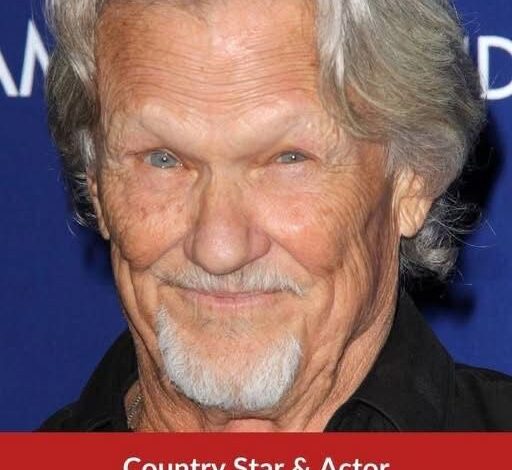
The passing of Kris Kristofferson at the age of 88 has left a profound void in the fabric of American culture, marking the end of an era for both the music industry and the silver screen. In a touching statement shared with the public, his family confirmed that the legendary artist passed away peacefully at his home on Saturday, September 28, surrounded by those who loved him. Their message was one of deep gratitude and spiritual solace, noting that they felt immensely blessed for the time they spent with him and encouraging his millions of fans to see his spirit in the natural beauty of the world. As the news of his departure resonates globally, it invites a comprehensive reflection on a life that was as rugged, intellectual, and transformative as the songs he wrote.
Born on June 22, 1936, in the border town of Brownsville, Texas, Kristofferson’s early life was defined by a unique intersection of military discipline and intellectual curiosity. As the son of a U.S. Air Force major general, he was raised in an environment that prioritized duty and excellence. He met these expectations with remarkable ease, distinguishing himself as a gifted student and a formidable athlete. His academic prowess eventually led him to one of the most prestigious honors a young scholar can achieve: a Rhodes Scholarship to Oxford University. It was during his time in England that his internal world began to expand beyond the military path laid out for him. At Oxford, he immersed himself in the romantic and rebellious literature of William Blake, while simultaneously maintaining a deep, soulful connection to the raw country sounds of Hank Williams. This synthesis of high-order poetry and grit-infused folk music would eventually become the hallmark of his creative identity.
Upon returning from his studies, Kristofferson initially honored his family’s legacy by joining the U.S. Army. He ascended to the rank of captain and became an accomplished helicopter pilot, yet the call of the song proved more powerful than the call of the cockpit. In a move that shocked many of his peers and disappointed his family, he walked away from a promising military career—and a teaching position at West Point—to pursue the uncertain life of a songwriter in Nashville. This was not a flight of fancy, but a total commitment to a craft he believed in. He arrived in Tennessee in the mid-1960s, a highly educated veteran willing to work from the ground up to learn the mechanics of the music business.
The Nashville of the late 1960s was a competitive and often rigid environment, and Kristofferson’s ascent was far from immediate. To support himself while honing his songwriting, he took on grueling, humble jobs, most famously working as a janitor at Columbia Records. It was a period defined by persistence and the legendary “Nashville hustle.” He was a man with a Rhodes Scholarship and a pilot’s license emptying ashtrays and mopping floors, all for the opportunity to be close to the creative process. His grit became the stuff of industry lore, particularly the story of him landing a helicopter on Johnny Cash’s lawn just to deliver a demo tape—a bold gamble that eventually forged one of the most significant friendships in music history.
The year 1970 acted as the Great Watershed for Kristofferson’s career. Almost overnight, his years of labor bore fruit as a series of his compositions became massive hits for other artists. “Me and Bobby McGee,” immortalized by Janis Joplin, became a generational anthem for freedom and the bittersweet nature of the road. “Sunday Mornin’ Comin’ Down,” performed by Johnny Cash, provided a visceral, unfiltered look at loneliness and the “morning after,” while Ray Price’s version of “For the Good Times” showcased Kristofferson’s ability to write with devastating emotional maturity. He did not just write country songs; he wrote literature set to melody. He introduced a new level of psychological depth and lyrical complexity to the genre, proving that a country song could be as intellectually rigorous as a poem by Blake.
Transitioning from a songwriter to a performer, Kristofferson released his debut album, Kristofferson, in 1970 to critical acclaim. His voice, characterized by a gravelly, lived-in quality, was the perfect vehicle for his stories of weary travelers, disillusioned lovers, and outsiders. He became a central pillar of the “outlaw country” movement, a rebellion against the polished, commercial “Nashville Sound.” Alongside fellow icons Willie Nelson, Waylon Jennings, and Johnny Cash, he championed a return to authenticity and artistic autonomy. This camaraderie eventually culminated in the formation of the supergroup The Highwaymen, an assembly of legends that cemented his status as a permanent fixture in the pantheon of American music.
However, Kristofferson’s influence was not confined to the recording studio. His rugged looks and natural, understated charisma made him an inevitable candidate for Hollywood. He carved out a prolific acting career, appearing in over 70 films and winning a Golden Globe for his role alongside Barbra Streisand in the 1976 remake of A Star Is Born. Whether he was playing a romantic lead, a gritty lawman, or a world-weary mentor, he brought a quiet intensity to the screen that mirrored the honesty of his lyrics. He was a rare talent who could command a stadium with a guitar just as easily as he could hold the attention of a cinema audience with a single glance.
Throughout his life, Kristofferson remained a man of deep convictions and social conscience. He used his platform to speak on behalf of the marginalized, often taking political stances that were considered risky for a country star. He lived his life with a radical honesty that prioritized truth over popularity, a trait that earned him the unwavering respect of his peers across the political and musical spectrums. Even as he faced health challenges in his later years, including memory loss that was later correctly attributed to Lyme disease, he continued to perform with a spirit of resilience that inspired everyone who saw him.
The legacy of Kris Kristofferson is one of profound synthesis. He bridged the gap between the academy and the honky-tonk, between the soldier and the poet, and between the songwriter and the movie star. He took the “common” language of country music and elevated it to the level of high art, ensuring that the stories of everyday people were told with the dignity and complexity they deserved. His songs were not just about “freedom being just another word for nothing left to lose”; they were about the human condition in all its messy, beautiful, and heartbreaking glory.
As the industry prepares to honor him through countless tributes and retrospectives, the true measure of his impact will be found in the thousands of songwriters who now feel empowered to write with greater depth because he paved the way. He taught us that bravery is not just found on a battlefield, but in the willingness to be vulnerable and honest about one’s own soul. When the sun sets on the hills of Nashville or the deserts of Texas, his voice will remain in the wind—a gravelly, comforting reminder of a man who mopped floors, flew helicopters, and changed the world with a pen and a guitar. Kris Kristofferson was a true American original, a poet of the people whose smile will indeed be seen in every rainbow for years to come.