David Lettermans question that left Jennifer Aniston very uncomfortable!
The landscape of late-night television has long been a mirror of the cultural standards of its time, but looking back through the lens of modern sensibilities, many once-celebrated moments have begun to lose their luster. David Letterman, once the undisputed titan of the late-night format, built a career on a foundation of irreverent wit, sharp irony, and a certain unpredictable edge. However, as the archives of The Late Show are revisited by a new generation, several of his interviews with high-profile women have sparked intense re-evaluation. Among the most frequently discussed are his encounters with Hollywood icon Jennifer Aniston—moments that, while dismissed as humor in the late nineties and mid-aughts, are now viewed as masterclasses in professional discomfort.
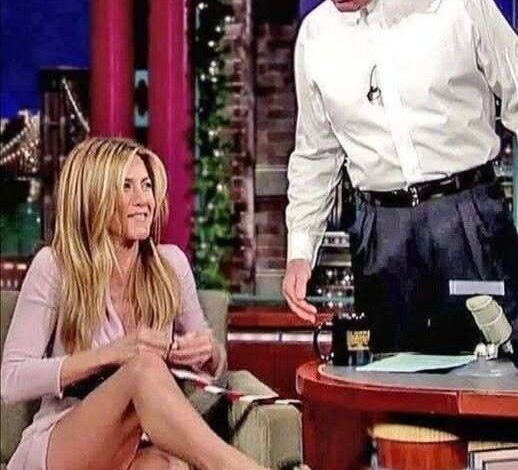
One of the most jarring instances occurred in 2006 during Aniston’s appearance to promote her romantic comedy, The Break-Up. From the moment she stepped onto the stage, the atmosphere was thick with a fixation that transcended typical talk-show banter. Dressed in a black button-down blouse and tailored black shorts, Aniston was immediately met with a relentless barrage of commentary regarding her physique. Letterman did not merely offer a passing compliment; he anchored the beginning of the segment to her legs, describing them as “tremendous,” “well-shaped,” and “muscular.”
The discomfort was not limited to the dialogue. The visual language of the show amplified the awkwardness, as the camera operators followed Letterman’s lead, executing tight zooms on Aniston’s legs while she sat in the guest chair. Aniston, ever the professional, attempted to deflect the attention with self-deprecating grace, attributing her choice of outfit to the oppressive New York heat. Yet, Letterman refused to pivot. Even as the conversation attempted to transition toward the film, he circled back to his fixation, remarking, “Your legs, you’ve got something there.” This persistent focus created a dynamic where a world-class actress was reduced to a set of physical attributes, her creative work and professional insights sidelined by the host’s preoccupation.
The interview grew increasingly intrusive as Letterman shifted his gaze from her appearance to her private life. At the time, rumors were swirling regarding Aniston’s relationship with her co-star, Vince Vaughn. Rather than discussing the craft of their collaboration or the production of the film, Letterman pressed her on the specifics of their rumored romance. He went so far as to ask if appearing nude in the movie had been Vaughn’s idea. Aniston, caught in a crossfire of personal and professional boundary-crossing, managed to maintain her composure, suggesting with a sharp but polite edge that Letterman should have directed such a question to Vaughn during his own appearance.
This 2006 encounter, however, was not an isolated incident. To understand the full context of Aniston’s history on The Late Show, one must look back to an infamous 1998 interview that remains one of the most surreal clips in late-night history. During that segment, Letterman leaned in toward Aniston, placed his hand on the back of her neck, and proceeded to take a strand of her hair into his mouth. The visual of Aniston’s stunned, frozen expression spoke volumes. When he eventually moved away, he handed her a tissue to wipe off the saliva—a gesture that added a layer of clinical awkwardness to an already invasive act. While the studio audience laughed at the time, the modern viewer sees a woman navigating a profound violation of personal space while being expected to maintain the “good sport” persona required of female celebrities in that era.
Despite these recurrent breaches of decorum, Aniston’s career is a testament to her immense resilience and class. She returned to the show in 2008, once again demonstrating her ability to rise above the limitations of her host. Promoting Marley & Me, she arrived in a chic pink party dress, prepared to dodge the inevitable questions about her then-relationship with musician John Mayer. However, this time, Aniston took control of the narrative through a clever and surprising gesture.
She presented Letterman with an early Christmas gift: the very Brooks Brothers necktie she had worn on the cover of GQ magazine. It was a meta-commentary on her own public image and a playful way to reclaim the conversation. As she helped Letterman put on the tie, she exclaimed, “This is exciting, I’m dressing Dave!” The host, unable to resist a final jab, made a quip about “guys with short ties,” but the power dynamic had shifted. Aniston had used her own “viral” moment to anchor the interview on her terms, providing a highlight that relied on her wit rather than her vulnerability.
Reflecting on these segments today, the conversation has moved far beyond the specific “leg” shots or the hair-sucking incident. It has become a broader discussion about the systemic expectations placed on women in the spotlight. For years, these moments were categorized as “playful” or “flirtatious,” but in the post-Me Too era, they serve as historical markers of the hurdles women had to clear just to promote their work. Aniston’s silence on these specific encounters over the years does not diminish the discomfort they caused; rather, her continued success and her ability to remain a beloved figure in the industry highlight her incredible professional stamina.
What was once dismissed as the eccentric humor of a late-night legend is now being scrutinized as a relic of a time when the boundaries of female guests were often considered negotiable for the sake of a punchline. These resurfaced clips remind us that while the humor of the past may have aged, the grace with which Jennifer Aniston navigated it remains timeless. As these discussions continue to evolve on social media and in cultural criticism, it becomes increasingly difficult to ignore the stark contrast between the host’s behavior and the guest’s enduring composure. The stories behind the screen, much like the movies Aniston was there to promote, often reveal more about the world they were made in than the people who starred in them.