Donald Trump Issues Stark Warning to Iran!
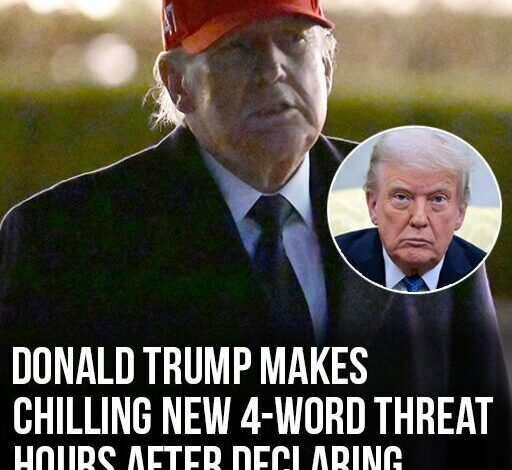
The geopolitical landscape of the Middle East has entered a period of heightened volatility following a direct and formidable warning from President Donald Trump addressed to the leadership in Tehran. This latest escalation centers on the Strait of Hormuz, a narrow yet globally indispensable maritime corridor that has once again become the focal point of international tension. As reports surfaced suggesting that Iranian officials might move to restrict or harass commercial traffic through this strategic waterway, the former president utilized his platform to signal that any interference with global oil shipments would be met with an uncompromising American response.
The specific catalyst for this exchange occurred on March 9, when Trump issued a statement via Truth Social. His remarks were a pointed reaction to rhetoric emerging from Iranian figures, who hinted that the safety of vessels transiting the strait could no longer be guaranteed if regional tensions continued to climb. For decades, the Strait of Hormuz has functioned as a primary pressure point in global diplomacy; it is the vital artery connecting the oil-rich Persian Gulf to the open span of the Arabian Sea and the Indian Ocean. Because it is the only sea passage from the Persian Gulf to the open ocean, it is arguably the most strategically important chokepoint in the world.
To understand the weight of this warning, one must look at the sheer volume of energy that flows through this narrow passage. A staggering percentage of the world’s daily oil consumption passes through the strait, including nearly all exports from Saudi Arabia, Iraq, Kuwait, and the United Arab Emirates. It is not merely a regional shipping lane; it is the foundation of global energy stability. Consequently, even the whisper of a disruption sends immediate tremors through international financial markets. Analysts have already noted a sharp uptick in crude oil prices, which have climbed to levels not witnessed in several years as traders and nations begin to factor in the “risk premium” of a potential blockade or military engagement in the Gulf.
In his communiqué, the former president framed any attempt by Iran to block the passage of oil as a direct act of economic aggression against the international community. By positioning the United States as the ultimate guarantor of maritime commerce, the warning signaled that Washington would not hesitate to employ “strong measures”—a phrase often interpreted as a precursor to kinetic military action—to ensure the channel remains unobstructed. This rhetoric serves as a deterrent intended to remind Tehran that the global economy’s reliance on the strait makes its closure a “red line” that transcends regional politics.
However, these warnings do not exist in a vacuum. They follow a period of intense military activity that has already reshaped the regional status quo. In the weeks leading up to this exchange, joint military operations involving the United States and Israel reportedly targeted key Iranian assets. These strikes were met with a series of retaliatory measures, including drone and missile salvos aimed at American and allied installations throughout the Middle East. This cycle of action and reaction has created a “tit-for-tat” dynamic that many fear could spiral into a broader, more conventional conflict if a miscalculation occurs in the crowded waters of the Persian Gulf.
For international observers and diplomats, the current situation represents a high-stakes game of brinkmanship. The Strait of Hormuz is a unique geographical feature where political disputes are instantly converted into global economic consequences. Because the navigable shipping lanes within the strait are only a few miles wide, even a small-scale naval incident or the placement of sea mines could effectively shut down the route, causing an immediate spike in energy costs that would be felt by consumers from New York to Tokyo. The interconnectedness of the modern world means that a localized conflict in this specific corridor has the power to trigger a global recession, influence political elections, and shift the foreign policy priorities of every major power.
As the international community monitors this unfolding crisis, the coming weeks are viewed as a critical window that will determine the trajectory of the region. There is a delicate balance at play: on one side, there is the drive toward de-escalation through back-channel diplomacy and economic pressure; on the other, there is the gravity of military calculations where every deployment is interpreted as a signal of intent. The presence of advanced carrier strike groups and land-based missile batteries in the region underscores the reality that the “cost of failure” in these negotiations is exceptionally high.
The Strait of Hormuz, in this context, has become more than just a logistical path for tankers; it has evolved into a symbol of the fragility of the globalized system. It serves as a stark reminder that the modern world’s infrastructure relies on the stability of a few key geographic locations. When tensions flare between a regional power like Iran and a global power like the United States, this narrow strip of water becomes a stage where the future of international trade is contested. The rhetoric from Donald Trump reflects a persistent American policy of maintaining the “freedom of navigation,” a principle that has been a cornerstone of maritime law and global stability since the end of the Second World War.
Ultimately, the focus remains on whether the current warnings will serve as a successful deterrent or if they will further entrench the opposing sides in a conflict of pride and strategic necessity. If the situation moves toward de-escalation, it will likely require a complex arrangement of security guarantees and economic concessions. If it escalates, the world may witness a confrontation that alters the geopolitical map of the 21st century. In this high-intensity environment, every radar signal, every public statement, and every naval maneuver carries the weight of potential history. The world watches the narrow waters of the Gulf, knowing that the smallest spark there could ignite a fire that reaches across every continent, affecting energy prices, trade flows, and the very security of the global order.