Every citizen who could be drafted if the US goes to war!
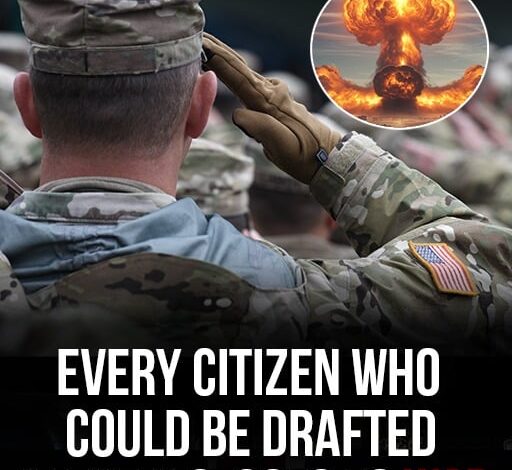
The prospect of a military draft in the United States is often discussed in the abstract, relegated to the pages of history books or the plots of dystopian cinema. However, as global tensions fluctuate in 2026, the reality is that the infrastructure for a national call-to-arms is not a relic of the past, but a meticulously maintained, modern apparatus. If the United States were to reinstate the draft, the transition would not be marked by immediate chaos or spontaneous mobilization. Instead, it would unfold with a cold, bureaucratic precision. The Selective Service System (SSS) is designed to move with silent efficiency from a dormant database to a full-scale deployment, a process that would fundamentally alter the lives of millions of citizens overnight.
The activation of the draft begins with the “Lottery Phase,” a high-stakes sequence managed by the Selective Service. Contrary to the image of a general call-up, the system follows a strict chronological hierarchy. The primary focus is on men who are in the calendar year of their 20th birthday. If a draft were initiated today, a televised lottery would be held, involving 366 capsules representing every possible birth date. The order in which these dates are drawn determines the “Random Sequence Number” for every registered man. A low number—such as 1 or 15—represents an almost certain summons to service, while a higher number offers a reprieve. Once the 20-year-old bracket is exhausted, the system expands outward to those aged 21, 22, 23, 24, and 25, before finally circling back to 19 and 18-year-olds.
However, the journey from receiving a Selective Service induction notice to standing on a parade deck is punctuated by a gauntlet of administrative and physical evaluations. The system is built on a foundation of exceptions, deferments, and complex gray areas that require a massive secondary infrastructure: the Local Boards. These boards, composed of civilian volunteers from the draftee’s own community, are the arbiters of “Hardship Deferments” and “Conscientious Objector” status. A young man might argue that he is the sole provider for a disabled parent or that his deeply held moral and religious convictions prevent him from bearing arms. These are not merely paperwork hurdles; they are rigorous tests of character and circumstance, where a few civilian signatures can change the trajectory of a life.
Medical histories would undergo similar scrutiny. In the 21st century, the definition of “fitness for service” has evolved to include a sophisticated understanding of mental health and chronic physical conditions that might have been overlooked during the Vietnam or Korean eras. Every potential draftee would undergo a comprehensive physical and psychological examination at a Military Entrance Processing Station (MEPS). Here, a significant portion of the modern population might find themselves disqualified for conditions such as asthma, severe allergies, or orthopedic issues—a reality that adds a layer of unpredictability to the “available” pool of personnel.
The question of professional and academic deferments remains one of the most debated aspects of the system. Historically, college students were able to postpone service until graduation, a policy that created significant social and economic disparities during previous conflicts. Current Selective Service protocols are designed to be more equitable; while a college student may be granted a deferment to finish a current semester (or a senior year), the long-term “student deferment” has been largely curtailed to ensure that the burden of defense does not fall exclusively on those without the means for higher education. Conversely, certain “critical workers”—those in defense manufacturing, healthcare, or high-level cybersecurity—might be diverted into support roles that keep the nation’s infrastructure intact, serving far from the front lines but remaining vital to the war effort.
One of the most significant legal and social boundaries of the current system is the exclusion of women. Despite decades of progress regarding gender equality in the military and the opening of all combat roles to women in 2015, the Military Selective Service Act currently applies only to “male persons.” While there have been numerous legislative proposals and court challenges aimed at requiring women to register for the Selective Service, the law remains unchanged in 2026. This creates a unique demographic imbalance in the “ready” pool, though many defense analysts argue that in a total war scenario, the demand for personnel would inevitably lead to a rapid legislative expansion of the draft’s reach.
[Image illustrating the demographic breakdown of the current US Selective Service registration pool by age and gender]
The machinery of the Selective Service is supported by an “invisible” registration process. Most young men register when they apply for a driver’s license, a student loan, or a government job, often without realizing the weight of the document they are signing. This data is stored in a secure, centralized system that is regularly audited and updated. The SSS also maintains a network of thousands of volunteer board members across all 50 states and U.S. territories, individuals who are trained and ready to be “activated” within days of a Congressional mandate. This “Standby” status is the ultimate insurance policy for national security—a mechanism that exists so that the nation never has to start from zero in the face of an existential threat.
Officially, the U.S. government maintains that there is no plan to reinstate the draft. The All-Volunteer Force (AVF) has been the cornerstone of American military power since 1973. However, the “unofficial” reality is that the machinery is closer to activation than many citizens dare to admit. In a world of rapidly shifting alliances and unconventional warfare, the ability to rapidly scale the military is a strategic necessity. The draft is the “break glass in case of emergency” tool of the American presidency. It is a system that transforms a citizen into a soldier through the intersection of a birth date, a medical exam, and a bureaucratic judgment.
Ultimately, the draft represents the ultimate social contract between a state and its people. It is a reminder that citizenship carries with it not just rights, but a latent, heavy obligation. While the streets are currently quiet and the lottery drums are empty, the database remains active. Every time a 18-year-old checks a box on a financial aid form, they are connecting themselves to this silent machine. It is a bureaucratic order waiting for a reason to speak, a reminder that in the face of global conflict, the distance between “civilian” and “soldier” is only as wide as a single number drawn in a room in Washington, D.C.
The existence of the Selective Service is a testament to the philosophy that a nation must always be prepared for the unthinkable. As we move further into the 21st century, the debate over the draft will likely continue to evolve, touching on issues of gender, technology, and the nature of service itself. But for now, the system sits in the shadows—monitored, updated, and ready to transform the lives of every eligible citizen should the call ever come.