Found a Hard, Foam-Like Brown Clump on Your Fence? Here is What It Might Really Be
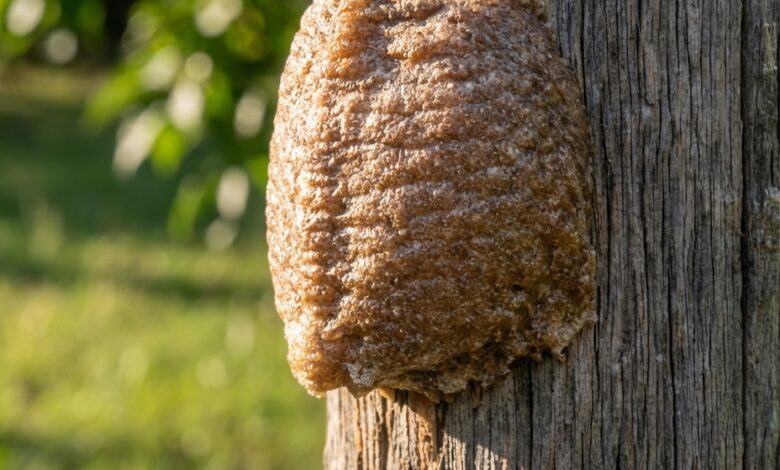
It begins as a subtle anomaly on the landscape of your backyard—a strange, architectural oddity clinging to the rough cedar of a fence post or the slender limb of a dormant rose bush. At first glance, it appears almost mechanical or industrial, like a dollop of hardened spray foam or a dried bit of mud that has been meticulously sculpted. It is hard to the touch, colored in shades of toasted tan or weathered bark, and possesses a ridged, papery texture that feels both fragile and indestructible.
Most homeowners, fueled by the instinct to prune and polish their outdoor spaces, see this as an intrusion. They reach for a scraper or a gloved hand, prepared to flick the “growth” into the grass. But to do so is to unknowingly dismantle one of nature’s most sophisticated survival pods. This brown, foam-like clump is not a fungus, nor is it the debris of a backyard project; it is an ootheca—the masterfully engineered egg case of the praying mantis.
The Architecture of Survival
The story of this mysterious clump began months ago, during the cooling twilight of late summer or early autumn. A female praying mantis, heavy with the next generation, sought out a stable anchor point for her offspring. Once she selected a site—be it a sturdy twig, a stone wall, or the underside of a fence rail—she began a biological manufacturing process that would put modern 3D printers to shame.
As she deposited her eggs, she simultaneously produced a frothy, liquid secretion from specialized glands. Using the tip of her abdomen, she whipped this fluid into a foam, much like a chef whisking egg whites into a meringue. As the foam met the air, it underwent a rapid chemical transformation, hardening into a tough, parchment-like material. This is the ootheca. It is a masterpiece of thermal insulation and structural integrity, designed to protect the vulnerable life within from the biting frosts of January and the prying beaks of hungry winter birds.
Inside this singular casing, nature has organized a complex nursery. Depending on the species—whether it be the native Carolina mantis or the larger, introduced Chinese mantis—the ootheca can house anywhere from fifty to several hundred eggs. These eggs are arranged in neat, vertical rows, separated by thin walls of the hardened foam, ensuring that each developing nymph has its own corridor of safety.
The Winter Vigil
Throughout the winter, the ootheca remains a silent, brown sentinel in your garden. It is a biological time capsule, oblivious to the snow and wind. The “foam” is a highly effective insulator; while the exterior may be battered by freezing rain, the interior maintains a stable environment that prevents the eggs from desiccating or freezing solid.
During this dormant phase, the mantis embryos are in a state of diapause—a physiological pause in development that ensures they do not hatch prematurely during a deceptive mid-winter thaw. They are waiting for the specific environmental cues of spring: a consistent rise in temperature and the lengthening of days.
The Great Emergence
When the spring sun finally warms the fence post to a consistent degree, the ootheca undergoes a dramatic transformation. What was once a static, woody clump becomes a bustling exit terminal. The tiny mantis nymphs, known as “hatchlings,” emerge almost simultaneously. They are miniature replicas of the adults, barely the size of a mosquito but already possessing the signature raptorial front legs and the piercing, inquisitive gaze of a predator.
This emergence is a spectacle of survival. The nymphs often hang from the ootheca by thin, silken threads, swaying in the breeze before they drop into the surrounding foliage. Within minutes of hatching, their soft exoskeletons harden, and they begin their first hunt. They do not need to be taught how to be predators; their survival is hardwired into their DNA.
The Gardener’s Silent Ally
The discovery of an ootheca on your property is more than just a biological curiosity; it is a certification that your backyard ecosystem is thriving. Praying mantises are “generalist predators,” meaning they do not discriminate in their diet. From the moment they hatch, they serve as a decentralized pest control squad.
A single mantis throughout its lifespan can consume thousands of insects. In their youth, they target tiny nuisances like aphids, leafhoppers, and fruit flies. As they grow, they move on to larger prey: moths, grasshoppers, flies, and even the notorious spotted lanternfly. By allowing the ootheca to remain on your fence, you are essentially deploying an organic, self-sustaining defense system that reduces the need for chemical pesticides and encourages a balanced food web.
Best Practices for Relocation
While the best course of action is to leave the ootheca exactly where the mother placed it, there are times when its location is problematic. If you are planning to paint your fence, prune the specific branch it occupies, or if the case is in a high-traffic area where it might be crushed, you can safely relocate it.
To do this, carefully clip the branch or scrape the case off the flat surface using a thin blade, being careful not to puncture the central egg chamber. You can then “glue” the case to a more suitable location using a small dab of non-toxic craft glue or by tying it to a sturdy shrub with a piece of twine. The key is to keep it off the ground, where moisture and ground-dwelling predators like ants could compromise the eggs. Ensure the exit holes (the central ridge of the case) are facing outward so the nymphs can emerge easily when the time comes.
A Lesson in Observation
The hard, brown clump on your fence is a reminder that the most significant events in nature often happen in plain sight, disguised as something mundane. It is a testament to the resilience of life and the intricate ways in which our gardens manage themselves when we step back and observe.
Next time you find yourself tidying the yard and come across one of these “foam” structures, resist the urge to clean. Instead, take a moment to appreciate the sophisticated engineering of the ootheca. You aren’t looking at a mess; you are looking at the future guardians of your garden, waiting for the first warm breath of spring to begin their work.