If You Were a Child or Teenager Between The 1950s And 1970s, You May Remember This Strange Object See it below!
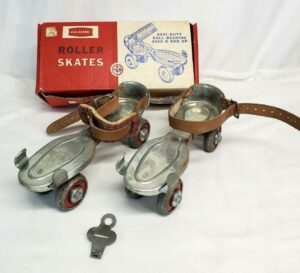
For those who spent their formative years navigating the sidewalks of the mid-20th century, the mere sight of a specific, industrial-looking metal contraption can trigger an immediate sensory overload. It is an object that, to a modern eye, might easily be mistaken for a specialized woodworking clamp or a heavy-duty bracket from a Victorian-era factory. Yet, for a child or teenager living between the 1950s and the 1970s, this “strange object” was the ultimate ticket to freedom, speed, and inevitably, a few skinned knees. We are talking, of course, about the vintage strap-on metal roller skate—the rugged, clanking ancestor to the sleek, aerodynamic inline blades of the 2020s.
Before the era of molded plastics, memory foam liners, and precision-engineered polyurethane wheels, roller skating was a much more visceral, mechanical experience. These yesteryear models were a far cry from the integrated boot-and-wheel designs we recognize today. Instead, they consisted of a telescoping metal chassis, four steel wheels that roared against the pavement, and a set of leather straps designed to lash the entire apparatus directly onto the user’s everyday shoes. To see them now is to see a masterpiece of mid-century utilitarian design, a tool built for durability rather than comfort, and an icon of a time when play was as much about grit as it was about fun.
The Anatomy of a Mid-Century Classic
The magic of these vintage skates lay in their adaptability. Because they were meant to be worn over shoes, they featured an adjustable metal base that could be lengthened or shortened by loosening a bolt in the center. This meant a single pair of skates could theoretically last a child through several growth spurts, or be shared among siblings with vastly different foot sizes. At the front, two adjustable metal clamps, often referred to as “toe clamps,” would grip the edges of the shoe’s sole.
The most critical component of this setup, however, was the skate key. This small, cross-shaped tool was the most prized possession of any neighborhood “speedster.” It was used to tighten the toe clamps and adjust the length of the metal base. Many children wore their skate keys on a piece of string or a shoelace around their necks like a talisman, a badge of membership in the local skating tribe. Without the key, you were grounded; with it, you were a mechanic of your own destiny.
The Experience: Steel on Pavement
Skating in the 1950s and 60s was not a quiet endeavor. The steel wheels were unforgiving, lacking the shock absorption of modern materials. When you hit the sidewalk, the sound was a rhythmic, metallic clack-clack-clack as the wheels crossed the expansion joints in the concrete. Every pebble was a potential hazard; a single stray stone could bring a steel wheel to a dead stop, sending the rider tumbling forward.
Because the skates were strapped over regular shoes—often Keds, PF Flyers, or sturdy leather school shoes—the connection between the foot and the skate was never quite perfect. There was always a bit of “wobble,” a slight sliding of the heel that required a specific kind of ankle strength to manage. The leather straps, which buckled around the ankle, were notorious for pinching or rubbing, and by the end of a long summer afternoon, the tell-tale marks on a child’s shins were as much a part of the experience as the wind in their hair.
A Cultural Phenomenon
The popularity of these metal skates peaked during an era when the street was the primary playground. In suburban neighborhoods across North America and Europe, the sidewalk was the venue for races, games of “tag” on wheels, and the simple, repetitive joy of “cruising.” It was a social activity that bridged age gaps; teenagers would use them to commute to the local soda shop, while younger children practiced their balance on the driveway.
These skates also represented a transition in manufacturing. Companies like Chicago Roller Skate Company and Union Hardware produced these items by the millions, using heavy-gauge steel that was built to survive decades of abuse. It is not uncommon today to find these skates in antique shops or grandparents’ attics, still fully functional, their wheels still spinning with that distinctive, high-pitched metallic whir. They are a testament to an era of “over-engineering,” where toys were expected to be passed down through generations.
The Evolution Toward the Modern Rink
As the 1970s progressed, the aesthetic of roller skating began to shift. The introduction of the “disco era” brought skating indoors to polished wooden rinks. This environment demanded more finesse and less “clank.” The heavy metal strap-ons began to give way to the “quad” skate—the boot with four wheels permanently attached—which allowed for dance moves, spins, and a level of control that the old sidewalk skates could never provide. Shortly thereafter, the invention of polyurethane wheels changed the game forever, offering a smooth, silent ride that made the old steel wheels feel like relics of the Stone Age.
Yet, for those who remember the original metal models, the modern versions feel almost too easy. There was a certain pride in mastering the heavy, clunky, strap-on skates. It was a skill that required maintenance, mechanical tinkering with the skate key, and a high tolerance for vibrations that could make your teeth chatter.
The Legacy of the “Strange Object”
Today, when we look at these metal skates, we see more than just an old toy. We see a reflection of a different philosophy of childhood—one that was perhaps a little more rugged and a little less cushioned. The “strange object” that looks like a woodworking tool is a physical link to a generation that transformed the concrete sidewalks of the world into their own private racetracks.
It is a reminder that before we had apps to track our movement or high-tech gear to optimize our performance, we had a piece of steel, a leather strap, and a key around our necks. And for millions of children between the 1950s and the 1970s, that was more than enough to conquer the world, one sidewalk crack at a time. The clatter of those steel wheels may have faded into history, but the spirit of the kids who wore them—bold, adventurous, and unafraid of a little grit—remains a cherished part of our collective memory.