Irans new supreme leader delivers worrying threat in first statement!
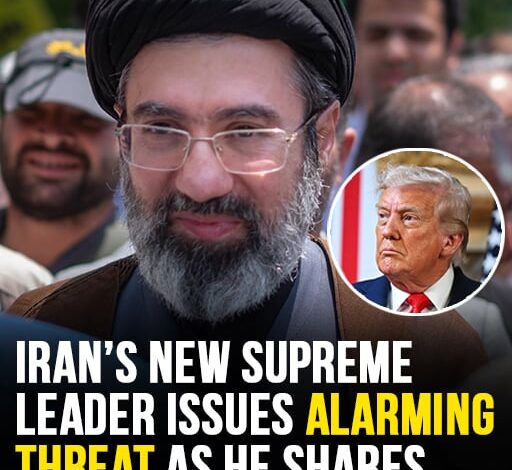
The geopolitical landscape of the Middle East, already fractured by decades of ideological and territorial strife, has recently been thrust into a profound state of uncertainty following a seismic shift in the Iranian leadership structure. For years, the question of succession within the Islamic Republic was whispered in the corridors of power in Tehran and analyzed with clinical intensity by intelligence agencies across the globe. Now, that theoretical crisis has collided head-on with the brutal reality of a volatile regional war, placing Mojtaba Khamenei—the son of the late Supreme Leader—at the absolute center of a gathering storm. Whether he operates as the definitive hand at the helm or a spectral figurehead shrouded in the mystery of the transition, his emergence has fundamentally altered the stakes of the ongoing conflict.
His inaugural statement, notably delivered not in person but through the proxy of a state news anchor, was devoid of the diplomatic platitudes or calls for de-escalation that some international observers had cautiously hoped for. Instead, the message was a chillingly precise articulation of a hardline agenda—a declaration that was less an introductory greeting to the world stage and more an overt threat to his perceived enemies. Mojtaba’s rhetoric centered on a promethean vow to avenge every “martyr” associated with the regime’s cause, specifically emphasizing that this quest for retribution extends far beyond the loss of his father. He spoke of an impending “compensation” to be exacted from Iran’s adversaries, a term that carries a heavy, transactional weight in the context of asymmetric warfare and economic sabotage.
Perhaps most rattling to global markets and foreign ministries was the explicit naming of the Strait of Hormuz as a strategic lever. By identifying this vital maritime artery—the literal lifeline of global oil supplies—as a point of pressure, the new leadership has signaled a willingness to weaponize the global economy to achieve its regional objectives. The mention of the Strait is a calculated reminder of Iran’s ability to induce a worldwide energy crisis, a move that suggests the new administration in Tehran is prepared to move past proxy skirmishes and toward a direct, high-stakes confrontation with the international order.
However, beneath the bravado of the official broadcasts lies a pervasive and deepening unease regarding the true state of Iranian governance. The decision to deliver such a pivotal statement through a media surrogate has only intensified the swirling rumors concerning Mojtaba’s physical condition and his actual level of command. Conflicting reports regarding potential injuries sustained during recent strikes, coupled with his prolonged absence from the public eye, have created a vacuum of certainty. In the rigid, top-down hierarchy of Iran’s security apparatus, the question of “who truly controls the button” is of paramount importance. If Mojtaba is indeed incapacitated or acting merely as a mouthpiece for a collective of elite military commanders, the risk of miscalculation increases exponentially as various internal factions vie for dominance.
The content of his speech further reinforced a shift toward a more aggressive military posture. By lavishing praise upon “brave fighters” and discussing the opening of “new, vulnerable fronts,” the statement points toward a strategy of expansion rather than consolidation. This suggests a leadership that is not merely reacting to external pressure but is actively seeking to export the conflict into new territories, potentially targeting regional neighbors who have historically remained on the periphery of the direct fighting. The mention of “any means available” serves as a hauntingly vague catch-all for unconventional warfare, cyber-attacks, or the mobilization of further paramilitary proxies across the Levant and the Arabian Peninsula.
For the international community, the ambiguity of Mojtaba’s role—whether he is a wounded hardliner seeking to prove his mettle through blood or a symbolic figurehead used to maintain the illusion of continuity—is almost as dangerous as the threats themselves. Foreign chancelleries from Washington to Beijing are currently tasked with decoding a leadership that seems to thrive on opacity. In the high-pressure environment of the Middle East, where a single misread signal can trigger a full-scale conflagration, the lack of a visible, accountable leader in Tehran creates a dangerous fog of war. The rhetoric suggests a regime that views regional stability as a secondary concern to the preservation of its own revolutionary legacy and the pursuit of a scorched-earth policy of “compensation.”
The psychological impact of this first statement cannot be overstated. By leaning so heavily into the language of martyrdom and vengeance, Mojtaba Khamenei is appealing to the most radicalized elements of the regime’s power base, effectively closing the door on any immediate back-channel negotiations or moderate reforms. This “gambler’s” approach to leadership indicates a belief that the only way to survive the current crisis is to accelerate through it, forcing the world to choose between total submission to Iranian regional hegemony or a catastrophic escalation that could reshape the global map.
As the world watches the silent streets of Tehran and the turbulent waters of the Persian Gulf, the weight of Mojtaba’s words continues to reverberate. He has set a tone of defiance that leaves very little room for retreat. For the families in the region who have already suffered through years of instability, and for the global powers attempting to navigate this new era of Iranian politics, the message is clear: the transition of power in the Islamic Republic will not be a quiet affair. It will be defined by a renewed commitment to the ideologies of the past, fueled by the grievances of the present, and executed with a level of aggression that the world has not seen in decades.
The global energy sector remains particularly on edge, as any disruption to the Strait of Hormuz could lead to an immediate and dramatic spike in oil prices, triggering a domino effect of inflation and economic stagnation across both developed and developing nations. This economic leverage is perhaps the most potent weapon in the new leader’s arsenal, and his willingness to mention it so early in his tenure suggests it is a cornerstone of his foreign policy. Whether this is a bluff designed to force concessions or a genuine precursor to a blockade remains the most urgent question of the hour.
Ultimately, the emergence of Mojtaba Khamenei represents a critical juncture in history. The transition from the era of his father to this new, more shadowed administration marks the beginning of a chapter that will be written in the language of “fronts,” “martyrs,” and “compensation.” While the physical reality of the man himself remains hidden, the shadow he casts over regional stability is vast and growing darker by the day.