Physically Healthy 28-Year-Old Explains!
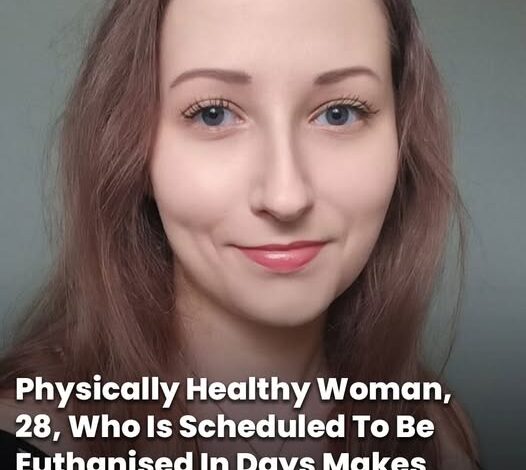
In the quiet landscapes of the Netherlands, a 28-year-old woman named Zoraya ter Beek has become the focal point of a profound and polarizing global conversation. Physically, she is in the prime of her life; yet, she has legally scheduled her own death for next month. Her decision to undergo elective euthanasia has sent shockwaves through the international community, not because of the act itself—which has been legal in her country for decades—but because her eligibility rests entirely upon psychiatric suffering rather than a terminal physical diagnosis. Her story has forced a modern society to grapple with the most uncomfortable of questions: when does the mind’s agony become as incurable as a spreading malignancy?
Zoraya’s life is defined by a triad of invisible burdens: severe, treatment-resistant depression, autism, and borderline personality disorder. For over a decade, her existence has been a grueling marathon of clinical interventions. She has navigated the labyrinth of modern psychiatry, enduring years of intensive therapy, a rotating cabinet of medications, and various specialized care programs. In her own words, the suffering did not stem solely from the conditions themselves, but from the relentless cycle of “hope followed by disappointment.” Each new treatment promised a horizon of relief that never materialized, eventually leaving her in a state of profound emotional exhaustion. When her psychiatrist finally admitted that they had exhausted all medical avenues, Zoraya found her clarity not in a new prescription, but in a final exit.
Under the Dutch Euthanasia Act of 2002, the procedure is not a right granted on demand, but a medical intervention restricted by rigorous “due care” criteria. To qualify, a patient’s suffering must be deemed “unbearable with no prospect of improvement.” Historically, this was applied to those in the end stages of cancer or neurodegenerative diseases. However, the interpretation has expanded to include psychiatric illnesses, provided the patient is mentally competent and the desire for death is “voluntary and well-considered.” Zoraya’s case met these high bars after an extensive evaluation process involving multiple independent physicians and psychiatrists who reached a somber consensus: her psychological pain was as intractable as any terminal physical ailment.
The announcement of her scheduled passing has reignited a fierce ethical war. On one side are the proponents of “right-to-die” legislation, who argue from a foundation of radical empathy and personal autonomy. They contend that to distinguish between physical and mental pain is a form of medical discrimination. If a patient with bone cancer can choose to avoid the final, agonizing weeks of life, why should a patient trapped in the “black dog” of incurable depression be forced to endure decades of mental torment? For these advocates, Zoraya’s choice is the ultimate expression of dignity—a way to reclaim her narrative from a series of disorders that have stolen her peace. They point to the Dutch system’s safeguards as evidence that this is a compassionate, regulated alternative to the trauma of lonely, violent suicides.
However, the opposition is equally vocal and deeply troubled. Many mental health professionals and bioethicists argue that the very nature of Zoraya’s conditions—depression and borderline personality disorder—is characterized by a sense of hopelessness. They suggest that the “desire for death” is not a rational choice but a symptom of the illness itself. Critics fear the “slippery slope” is no longer a metaphor but a reality, suggesting that by allowing euthanasia for psychiatric reasons, society is effectively “giving up” on the vulnerable. There is a haunting concern that normalizing death as a solution for psychological distress may disincentivize the pursuit of breakthrough treatments or, worse, send a message to the neurodivergent community that their lives are fundamentally unlivable.
Beyond the clinical and ethical debates lies the human reality of Zoraya’s final days. She has approached her end with a meticulous, haunting pragmatism. She plans to spend her final moments in the familiar surroundings of her home, sitting on her sofa with her partner by her side. There will be no hospital gown, no sterile white lights—only a lethal infusion administered by a doctor in a setting of her choosing. She has even requested cremation to ensure that her partner is not burdened with the upkeep of a grave, a final act of perceived mercy for the one she is leaving behind. Despite the weight of her decision, she speaks of a “quiet liberation.” The fear of the unknown remains, but it is eclipsed by the relief of knowing the marathon is almost over.
This case has highlighted a growing trend in the Benelux countries and Canada, where “Medical Assistance in Dying” (MAID) is increasingly scrutinized as it expands into the realm of mental health. Statistics show that while psychiatric euthanasia still accounts for a small percentage of total cases, the numbers are rising, particularly among young women. This demographic shift has led to uncomfortable questions about societal failures—whether a lack of community support, the isolation of the digital age, or the inadequacies of the mental health system are driving people toward the needle.
For the medical community, Zoraya ter Beek represents the ultimate challenge to the Hippocratic Oath. Doctors are trained to “do no harm” and to preserve life at all costs. Yet, in the Dutch model, “mercy” is redefined. The harm is seen not in the act of ending life, but in the forced prolongation of a life that has become a cage. It is a fundamental shift from “curing” to “caring,” even when that care takes the form of a final, permanent sleep.
As the date of her procedure approaches, Zoraya remains steadfast, ignoring the global storm her choice has created. She sees herself not as a symbol or a warning, but as a person who has simply run out of options. Her story serves as a mirror held up to the world, reflecting our deepest fears about suffering and our conflicting definitions of mercy. Whether one views her as a pioneer of personal liberty or a victim of a culture that has lost its way, her life and impending death have forced a global audience to confront the most fragile moral lines of the 21st century.
The debate will not end when Zoraya’s heart stops. Instead, it will likely intensify, as other nations look to the Netherlands to see the consequences of a society that grants its citizens the ultimate authority over their own exit. For Zoraya, the politics and the protests are secondary; she is merely a woman waiting for the end of a long, dark night, hoping that on the other side of the needle, there is finally the silence she has been searching for.