SCOTUS Decision On Mail-In Voting Rules Could Impact Elections Going Forward!
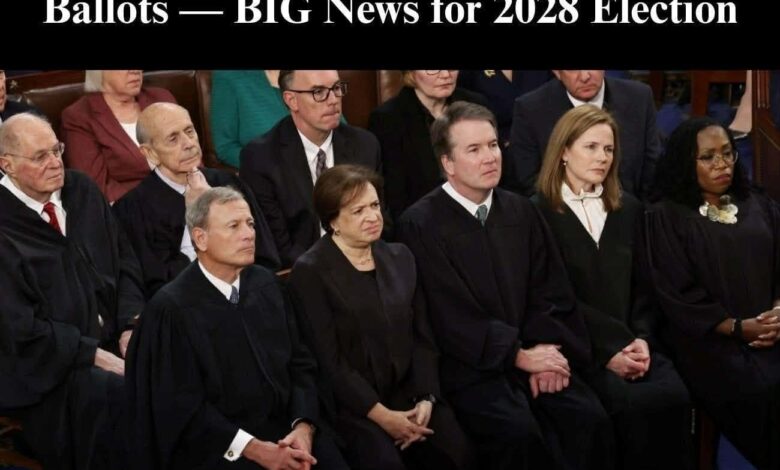
In the ever-shifting landscape of American democracy, the halls of the U.S. Supreme Court have once again become the epicenter of a legal storm that could fundamentally reshape how millions of citizens cast their votes and how those votes are counted. At the dawn of 2026, two pivotal cases—Watson v. Republican National Committee and the recently decided Bost v. Illinois State Board of Elections—are converging to create a new judicial framework for election law, one that prioritizes procedural “integrity” and grants unprecedented power to political candidates to challenge the rules of the road.
At the heart of this controversy is a seemingly simple question: When does “Election Day” actually end? For decades, dozens of states have operated under “grace period” or “postmark” rules. These statutes allow mail-in or absentee ballots to be counted as long as they are postmarked by Election Day, even if they arrive at the registrar’s office several days later. This practice, which expanded dramatically during the 2020 pandemic, was designed to ensure that voters were not disenfranchised by mail delays or logistical hurdles. For military members serving overseas, rural voters, and college students, these few extra days are often the difference between their voice being heard or their ballot being discarded.
However, a new legal theory is aggressively challenging this status quo. In November 2025, the Supreme Court agreed to hear Watson v. Republican National Committee, a case originating in Mississippi. The Republican National Committee (RNC) argues that federal law establishing a single, uniform Election Day—the first Tuesday after the first Monday in November—preempts state laws that allow for an extended receipt window. According to this argument, an “election” is not merely the act of a voter marking a ballot, but the formal “consummation” of the process, which they contend must occur within the 24 hours of that specified Tuesday.
If the Court aligns with the RNC’s interpretation, the consequences would be immediate and profound. Approximately 30 states currently allow some form of a grace period for ballot receipt. A ruling requiring ballots to be in the hands of officials by the close of polls on Election Day would effectively invalidate these laws, potentially disenfranchising hundreds of thousands of voters—including the four million U.S. service members and overseas citizens who rely on the reliability of the postmark to navigate international mail systems.
While the nation awaits the Watson decision, a separate but equally consequential ruling was handed down in January 2026: Bost v. Illinois State Board of Elections. This case did not focus on the legality of late-arriving ballots themselves, but rather on the threshold question of who is allowed to sue over them. In a 7–2 decision, the Court ruled that federal candidates—in this case, Representative Mike Bost of Illinois—have automatic “standing” to challenge election rules in the races they are running.
Writing for the majority, Chief Justice John Roberts adopted a categorical rule: a candidate’s interest in the “integrity of the election” and the “fairness of the process” constitutes a concrete injury, even if they cannot prove that a specific rule will cause them to lose or cost them money. This is a significant departure from previous judicial standards, which typically required a plaintiff to show a “concrete and particularized injury” that could be redressed by the court. By granting candidates this nearly universal right to sue, the Court has essentially “front-loaded” election litigation.
The impact of Bost is already being felt as the 2026 midterms approach. By lowering the standing threshold, the Court has opened a “legal floodgate,” making it exponentially easier for candidates to challenge everything from the placement of drop boxes to the specific procedures for signature verification long before a single vote is cast. Critics argue that this creates a “litigation-first” election culture, where the judiciary exerts increased control over election mechanics based on predictive harms rather than real-world evidence. As Justice Ketanji Brown Jackson noted in her dissent, this could improperly thrust the judiciary into the political arena, allowing candidates to use the courts as a strategic arm of their campaigns.
The tension between these two cases highlights a broader ideological rift. On one side, “election integrity” groups—including the Honest Elections Project and the Center for Election Confidence—argue that clear, hard deadlines are essential for public trust. They contend that counting ballots for days after the polls close “unnecessarily damages public trust,” delays results, and invites skepticism of the final tally. From this perspective, the “postmark rule” is a loophole that undermines the finality of Election Day.
On the other side, voting rights advocates and military organizations—such as Blue Star Families and the U.S. Vote Foundation—argue that the RNC’s theory ignores a century of accepted practice. They point out that federal law has long incorporated state receipt rules, especially for overseas voters. For these advocates, the “Election Day” statutes were never intended to regulate the receipt of mail, but rather the casting of the vote. They warn that a “bad decision” in Watson would be the opposite of what Congress intended when it passed the Uniformed and Overseas Citizens Absentee Voting Act of 1986.
As the Court prepares for oral arguments in Watson on March 23, 2026, the 2026 primary season is already underway. In Texas, new U.S. Postal Service guidance has already complicated the landscape, as the USPS warned it might not postmark mail on the same day it takes possession. This logistical shift, combined with the legal uncertainty in Washington, means that voters are being urged to mail their ballots earlier than ever before to avoid being caught in a procedural crossfire.
The final decisions in these cases will likely arrive by the summer of 2026, just as the midterm campaigns enter their most feverish stage. Regardless of the specific outcome, the Supreme Court has already signaled a new era of judicial involvement in the “rules of the game.” By broadening who can sue and narrowing the window for when a vote is considered “timely,” the Court is redefining the boundaries of the American electorate. For the millions of Americans who have come to rely on the postmark as a safeguard of their democratic participation, the coming months will determine whether that safeguard remains a pillar of the process or a relic of the past.