Silent Warning On Grandpas Neck!
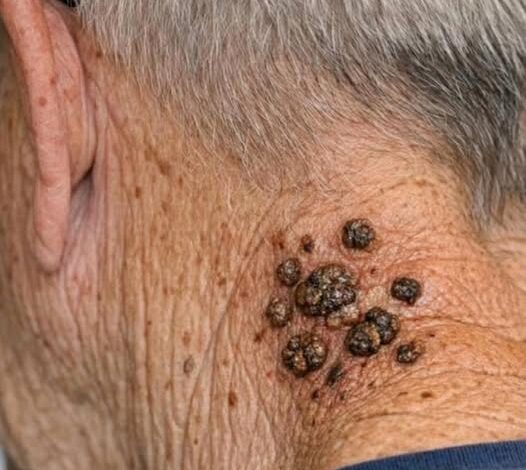
The human skin is a living historical record, a vast and complex organ that meticulously charts the passage of time. As we age, the smooth landscape of youth gives way to a more textured geography—one marked by the fine lines of laughter, the deeper furrows of worry, and an array of mysterious biological markers. Among the most common yet unsettling features of this maturing terrain are the small, raised growths that often appear on the necks, chests, and backs of our elders. To a grandchild resting their head on a grandfather’s shoulder, a dark, waxy bump on his neck can feel like a silent warning, a physical manifestation of the vulnerability that comes with the autumn of life. However, in the vast majority of cases, these “ominous” spots are not a harbinger of disease, but a benign hallmark of longevity known as seborrheic keratosis.
Seborrheic keratosis is perhaps the most frequent non-cancerous skin tumor encountered in individuals over the age of 50. Despite its clinical-sounding name, it is essentially a harmless overgrowth of the top layer of skin cells. These growths are often referred to as “wisdom spots” or “barnacles of aging,” a poetic nod to their tendency to accumulate as the decades pass. They are characterized by a very specific aesthetic: they appear to be “stuck on” to the skin, almost as if a piece of dark candle wax or a small raisin had been pressed onto the surface. They can range in color from a pale, sandy tan to a deep, obsidian black, and their texture can vary from smooth and velvety to rough, crumbly, and verrucose.
The biological mechanism behind seborrheic keratosis is a localized proliferation of keratinocytes—the primary cells of the epidermis. While the exact cause remains a subject of dermatological study, there is a strong genetic component; if your parents or grandparents developed these “barnacles,” it is highly likely that you will as well. Exposure to sunlight over many years may also play a role, though these spots frequently appear in areas that rarely see the sun, such as the torso or undergarment lines. Unlike moles, which involve the pigment-producing melanocytes, seborrheic keratoses are purely epidermal. They do not have roots, they do not spread through the bloodstream, and—most importantly—they are not precursors to skin cancer. They are biological dead ends.
However, the “danger” of seborrheic keratosis is psychological rather than pathological. Because they can appear suddenly and grow relatively quickly, they often trigger a profound sense of “cancer anxiety.” A dark, irregular spot appearing on a loved one’s neck can mimic the visual profile of melanoma, the most serious form of skin cancer. This mimicry is what leads to the “silent warning” felt by family members. The human brain is wired to detect anomalies, and a new, dark growth is a high-level anomaly. The stress of “not knowing” can be more corrosive to a person’s well-being than the growth itself.
This is where the power of clinical reassurance becomes a vital tool for family harmony. A trained dermatologist can usually identify a seborrheic keratosis within seconds of a visual examination. In many cases, they utilize a tool called a dermatoscope—a specialized magnifying lens with a polarized light source—to see through the top layer of the skin. Under the dermatoscope, seborrheic keratoses reveal tell-tale signs like “keratin pearls” or “milky cysts” that are absent in malignant growths. For a grandfather who has been quietly worrying about a spot for months, this five-minute consultation can provide a transformative sense of relief.
While these growths are medically harmless, they can become a physical nuisance. Because they sit on top of the skin, they are easily snagged by shirt collars, necklaces, or towels. When irritated, they can itch, bleed, or become inflamed, further mimicking the symptoms of something more sinister. In such cases, or if the patient simply finds the growth aesthetically displeasing, removal is a straightforward outpatient procedure. The most common method is cryosurgery, where liquid nitrogen is used to flash-freeze the growth, causing it to fall off naturally within a week or two. Alternatively, a clinician may perform a “shave excision” or curettage, gently scraping the growth away with a sterilized blade. Because the growth is superficial, these procedures rarely leave a significant scar, often resulting in nothing more than a faint, pale patch that fades over time.
The broader lesson of the “bump on Grandpa’s neck” is one of proactive vigilance tempered by informed calm. In the world of 2026, where health information—and misinformation—is available at the click of a button, it is easy to fall into a spiral of self-diagnosis and worst-case scenarios. The modern approach to skin health is built on the principle of “The Ugly Duckling Sign.” If a person has dozens of similar-looking “wisdom spots,” they are likely all benign. However, if one spot looks significantly different from the others—if it has jagged borders, multiple colors, or if it has changed rapidly in size—it is the “ugly duckling” that requires professional eyes.
Encouraging an aging parent or grandparent to get their skin checked is an act of love. It is a way of saying, “Your health matters to me, and I want you to live without the weight of silent fear.” For many seniors, there is a generational tendency to “not make a fuss” or to ignore physical changes out of a fear of what a doctor might find. By framing the visit as a routine “tune-up” or a simple way to get “clear, informed reassurance,” family members can help their elders trade anxiety for peace of mind.
Ultimately, seborrheic keratoses are a badge of a life well-lived. They are a sign that the body has successfully navigated decades of environmental stressors and biological shifts. They are common, they are predictable, and they are overwhelmingly safe. By understanding the science behind these waxy “stuck-on” spots, we can look at the changing skin of our elders not with alarm, but with the same affection we have for the stories they tell. The “silent warning” on a grandfather’s neck is, more often than not, just a whisper from the past—a reminder that while our outer shells may change and accumulate the “barnacles” of time, the person underneath remains as vital and cherished as ever. The real power is in refusing to let fear occupy the space where understanding should live.