The Real Reason Womens Shirts Button Differently from Mens
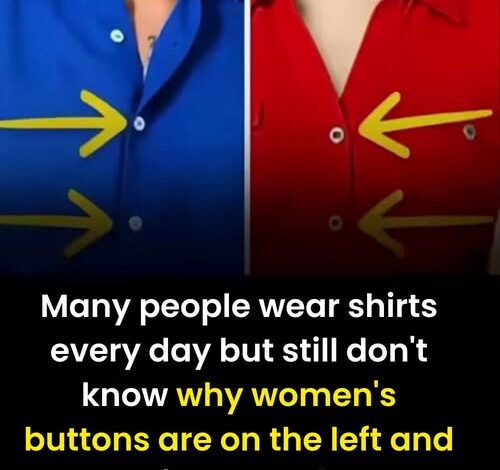
You button your shirt without thinking, but what you’re really doing is replaying a piece of history so old and so ingrained that most people have no idea they’re participating in it. Every morning, as your fingers reach instinctively to one side or the other, you’re brushing against the remnants of a world built on class, gender, and power — a world that stitched its rules into clothing and expected everyone to obey without question.
The strange divide is so normalized that it feels invisible: men’s shirts button right over left; women’s button left over right. The fabrics change, the fashion shifts, the silhouettes evolve, but that little detail refuses to die. It hangs on like a ghost of the past, a tiny seam that tells a much bigger story.
To understand how it began, you have to picture life before zippers, washing machines, or even the idea of getting dressed alone. In wealthy households — the only places where clothing with buttons existed at first — dressing wasn’t a solo activity. It was a ritual, a status symbol, sometimes even a performance. Women of high social standing rarely put on their own garments. They stood still, arms lifted, while right-handed maids dressed them piece by piece. Because the dresser stood facing the woman, buttoning the garment was easier when the buttons were on the woman’s left. A simple matter of convenience — but convenience for the servant, not the woman wearing the clothing.
Men, on the other hand, dressed themselves. Not only that, but many men were expected to be prepared for combat, hunting, or self-defense. Fast access to a weapon mattered. When a right-handed man needed to reach inside his shirt or jacket quickly, buttons on the right made it easier. Clothing had to accommodate action, speed, and autonomy, so men’s garments developed in that direction. Even long after swords and pistols stopped living beneath layers of fabric, the button placement stayed fixed, a lingering habit from centuries when men’s clothing was designed for self-reliance and authority.
Over time, that purely functional difference solidified into social coding. What started as a practical decision became a cultural symbol — a quiet design rule that separated the dressed from the dressers, the dependent from the autonomous, the ornamental from the functional. Women’s clothing buttoned differently not because women’s bodies needed it, but because society expected women to be handled, arranged, and adorned by others. Men’s clothing buttoned the opposite way because men were expected to handle themselves.
These invisible expectations didn’t disappear when society changed. They merely slipped beneath the surface, hidden in the smallest details. When industrialization arrived, factories mass-produced shirts for the general public. This moment could have erased the asymmetry. Machines don’t care which side a button sits on, and most people were dressing themselves by then. But instead of resetting the design, manufacturers replicated the old distinctions without question. The divide became standardized, stamped into patterns, repeated endlessly, and taught unconsciously through each new generation of clothes.
Even now, in a world where people dress themselves regardless of gender, the divide holds. It’s no longer about maids or swords. It’s about a tradition that outlived its logic — a tiny museum exhibit sewn into every button-down shirt. Women’s garments subtly echo a past where they were expected to be helped, handled, or displayed. Men’s clothing still favors quick access and practicality, a nod to centuries when men were expected to fight, command, and act.
Most people never think about it. Their hands simply follow the pattern. Left-over-right or right-over-left, without a second thought. But those hands are reenacting a hierarchy older than modern democracy, older than electricity, older than the idea that men and women should dress themselves. Clothing carries our history quietly, and button placement is one of the most stubborn leftovers.
And that stubbornness says something. It speaks to how deeply baked our assumptions can be. Gender roles don’t only show up in obvious places — toys, jobs, expectations, laws. They also hide in tiny mechanical motions repeated day after day, so familiar we forget to question them. Clothing is one of the earliest forms of social communication. Long before words were common, clothes signaled status, identity, and belonging. They told the world how to treat you. In some ways, they still do.
Button direction became part of that early vocabulary. If you knew how to read it, you knew who was wealthy enough to be dressed by others, who was ready to fight, who belonged in which sphere. Even today, the divide speaks silently, though far fewer people understand the language.
We like to think society moves forward in clean lines, discarding outdated practices the moment they stop serving a purpose. But history rarely works that efficiently. It lingers. It clings to small corners. It attaches itself to everyday habits and hides in plain sight. Something as simple as a shirt can carry centuries of assumptions in its seams.
You might never look at your own clothing the same way again after realizing this. That’s the strange power of old traditions: once you see them, they stop being invisible. The next time you button a shirt, you’ll feel the ghost of the past hovering there, a reminder that the world you live in was built layer by layer, detail by detail, habit by habit. You may not have chosen the rules, but you’re still touching them every morning.
And maybe, just maybe, noticing that weight is the first step in shrugging some of it off.