THE SIN OF CREMATION according to the Bible says!
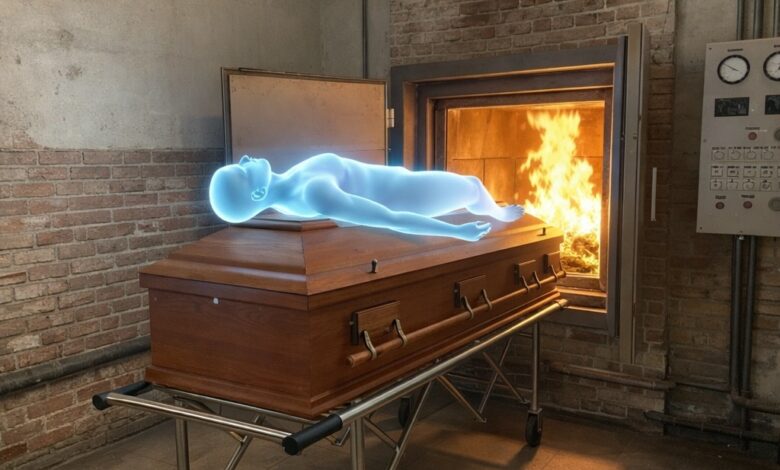
In recent decades, the landscape of end-of-life care has shifted dramatically across the Western world. What was once a rare practice has become a commonplace choice, driven by a complex tapestry of rising costs, dwindling urban burial space, and a growing societal emphasis on environmental sustainability. Many families now view cremation not as a departure from tradition, but as a practical and respectful alternative to the sprawling cemeteries of the past. However, within the Christian community, this shift continues to ignite profound theological questions. For those whose lives are anchored in scripture, the transition from the cemetery to the columbarium is not merely a logistical decision; it is an inquiry into the nature of the body, the sanctity of tradition, and the promise of the afterlife.
The central question—whether cremation constitutes a “sin” according to biblical standards—is one that often sparks spirited debate. This tension arises because the answer is not found in a single, clear-cut commandment, but rather in a nuanced intersection of historical custom, spiritual symbolism, and the broader narrative of the Christian faith. To understand the Christian hesitance toward cremation, one must first look at the overwhelming precedent set within the pages of the Bible. From the early patriarchs to the dawn of the New Testament, burial was the undisputed norm.
In the Old Testament, the act of burial was treated with immense gravity. Figures of monumental faith, such as Abraham and Moses, were laid to rest in the earth, and the denial of a proper burial was often viewed as a significant tragedy or a sign of divine judgment. This cultural preference was not accidental; it was rooted in a specific understanding of the human person. For the ancient Hebrews, and subsequently for early Christians, the body was not a mere vessel to be discarded once the soul had departed. It was seen as an integral part of the individual, created by God and destined for a future restoration.
The most powerful precedent for burial, however, is found in the life and death of Jesus Christ. The New Testament records that after His crucifixion, Jesus was laid in a tomb. For centuries, Christians have looked to the burial of Christ as the ultimate model for their own departure. Burial became a sacred symbol—a “sowing” of the body into the earth, much like a seed, in the quiet expectation of a future harvest. St. Paul famously utilized this agricultural metaphor in his letters, suggesting that the body is “sown in corruption” but will eventually be “raised in incorruption.” This imagery of the body resting in the earth like a seed waiting for the spring of the resurrection is a cornerstone of why burial has remained the preferred practice for two millennia.
Despite this strong traditional preference, a rigorous study of the Bible reveals a surprising silence: there is no explicit scriptural prohibition against cremation. There is no “thou shalt not burn.” While the Bible contains instances where bodies were burned, these were usually exceptional circumstances—often related to extreme judgment or the prevention of the desecration of remains in wartime. Because there is no direct moral law forbidding it, many modern theologians argue that cremation falls under the category of Christian liberty. They suggest that while burial may be the “biblical” custom, it is not a “biblical” requirement for salvation.
The debate often shifts toward the theological concept of the body as the “temple of the Holy Spirit.” Some believers argue that cremation represents a violent destruction of that temple, suggesting a lack of reverence for the physical form that God crafted. They worry that choosing to accelerate the natural process of decomposition through fire might signal a lack of faith in God’s ability to resurrect the dead. On the other side of the discourse, scholars point out that the physical state of the remains is irrelevant to the Creator’s power. If God can call the universe into being from nothingness, He is certainly capable of reconstituting a resurrected body regardless of whether the original remains were reclaimed by the sea, lost to fire, or slowly turned to dust in a wooden casket. The sovereignty of God over death is not limited by the chemistry of the remains.
Culturally, the history of cremation has added layers of unease for the faithful. In the early centuries of the Church, cremation was frequently associated with pagan rituals that denied the possibility of a resurrection. By choosing burial, early Christians were making a counter-cultural statement of hope. They were distinguishing themselves from a world that viewed death as an absolute end. In the modern context, however, the motivations for cremation have changed. Most people choosing cremation today are not doing so to make a theological statement against the resurrection; they are doing so to manage the staggering expenses of the modern funeral industry or to honor a desire for simplicity.
As the dialogue evolves, a consensus has emerged among a wide range of denominations: cremation does not affect one’s standing with God or the validity of one’s future resurrection. The essence of the Christian hope is not found in the preservation of the physical atoms that make up our current form, but in the transformative power of Christ’s victory over the grave. The promise of the Gospel is that we will be given new, glorified bodies that are no longer subject to decay. In this light, the resting place of the earthly remains—whether in a traditional grave or an ornamental urn—becomes a matter of personal and family conviction rather than a test of orthodoxy.
Ultimately, the choice between burial and cremation is a deeply personal journey of faith and stewardship. For some, the traditional burial remains a powerful, non-verbal sermon on the hope of the resurrection, a way to honor the physical body as it waits for the final trumpet. For others, cremation is a humble acknowledgement that we are but “dust and ashes,” and that our true security lies in the hands of the One who promises to make all things new.
In the final analysis, the Christian focus remains steadfastly fixed not on the tomb, but on the empty grave of Easter morning. Whether a believer is laid in the ground or their ashes are scattered to the winds, the core of the faith remains unchanged. It is a hope that transcends the physical state of our remains, resting entirely on the eternal promise of life beyond death. In the economy of God’s grace, the method of our departure is far less significant than the destination to which we are headed—a reality where neither fire nor decay can touch the life we have found in Him.