Twin-Engine Tragedy, Two Pilots Killed After Venezuela Plane Fails to Lift Off
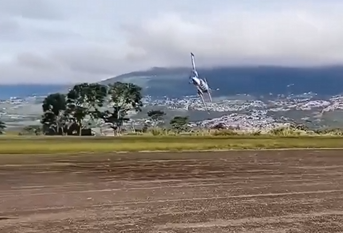
The pursuit of flight is an endeavor defined by precision, a delicate balance of physics and mechanics that usually results in the seamless transit of people and goods across the horizon. However, on the morning of February 18, 2026, that balance was tragically disrupted at Venezuela’s Paramillo Airport. What began as a routine departure under clear, stable skies rapidly devolved into a catastrophe that claimed the lives of two dedicated pilots and left the aviation community in a state of profound mourning. The incident, involving a twin-engine Piper PA-31T1 Cheyenne, has become a sobering focal point for discussions regarding regional aviation safety and the unpredictable nature of mechanical failure.
The timeline of the tragedy began at approximately 9:52 a.m. when the aircraft, registered under the tail number YV1443, was cleared for takeoff. To those watching from the terminal and the surrounding airfield, the initial roll down the runway appeared standard. However, as the nose of the Cheyenne lifted to begin its ascent, witnesses noted an immediate and jarring change in the auditory signature of the engines. Observers described hearing the twin engines fluctuate and sputter, a sound that signaled a desperate struggle for lift. Instead of the smooth, angled climb typical of a Piper PA-31T1, the aircraft appeared to “fail to lift off” effectively, clipping low over the runway as it fought against gravity.
The struggle was brief and devastating. Within moments of its initial ascent, the aircraft lost what little altitude it had gained and plunged back toward the earth. Upon impact, the fuselage erupted in a violent explosion, sending a thick column of black smoke into the Venezuelan sky. The airport’s immediate response was a testament to the training of its first responders; rescue teams and firefighters were mobile within seconds, arriving at the crash site to battle the intense flames that threatened to spread to nearby fuel storage areas and structures. Despite the rapid deployment of emergency services and the containment of the fire, the intensity of the crash proved fatal. Both pilots were pronounced dead at the scene, their identities withheld initially to allow for the private notification of their families.
In the immediate aftermath, the National Institute of Civil Aeronautics (INAC) took charge of the scene, issuing a formal statement to express deep condolences to the families of the fallen aviators. The agency confirmed that the Civil Aviation Accident Investigation Board (JIAAC) has been activated to conduct a full-scale inquiry. This investigation is tasked with dissecting the “critical malfunction” that occurred during those few seconds of flight. Because the weather was reported as stable and the aircraft had recently undergone routine maintenance checks, the focus has shifted toward more granular possibilities, including internal mechanical failure, fuel irregularities, or subtle human error.
The wreckage at Paramillo Airport currently serves as a grim laboratory for JIAAC investigators, who are meticulously analyzing flight data and engine components. One of the most haunting pieces of evidence comes from the residents who live near the airport perimeter. They described a sequence of events that began with the sound of struggling machinery and ended in a chilling silence before the final explosion. “It sounded like it was struggling to climb,” one witness recalled, capturing the final, frantic moments of the pilots as they likely fought to stabilize the failing aircraft. Their testimony, combined with air traffic control communications, will be vital in reconstructing the final seconds of YV1443.
This tragedy has reignited a much-needed dialogue regarding aviation oversight and safety standards at regional airports across Venezuela. While the response of the Paramillo rescue teams has been praised for preventing a larger-scale disaster, the crash itself raises questions about the maintenance cycles and safety protocols governing older twin-engine models like the Piper Cheyenne. Aviation experts suggest that tragedies like this serve as a “sobering reminder” of the inherent risks of flight and the relentless necessity for transparency in safety reporting. The goal of the JIAAC inquiry is not just to assign blame, but to uncover systemic vulnerabilities that could be addressed to prevent a similar heartbreak in the future.
As the investigation unfolds, the aviation world remembers the two pilots not for their final moments of tragedy, but for their service to the skies. The loss of two aviators is a wound that felt deeply by their peers, who recognize the skill and bravery required to command such machinery. For now, the nation waits for answers, hoping that the data recovered from the wreckage will provide the clarity needed to honor the memory of the deceased. The final flight of YV1443 ended in sorrow, but the lessons learned from its failure may one day protect the lives of others who take to the air.
The story of the Paramillo crash is currently being analyzed alongside other significant national events, including the emotional conclusion of the search for Nancy Guthrie, the mother of Savannah Guthrie. While these stories represent different types of loss—one a sudden mechanical tragedy and the other a prolonged missing person case—they both highlight a week defined by national mourning and the search for truth. In the case of the pilots, that truth lies within the charred engine components and the recorded voices of air traffic control. Until the JIAAC delivers its final report, the wreckage at Paramillo remains a silent monument to the two men who proudly flew until the very end.