Exploring the Symbolism of the Three-Dot Tattoo!
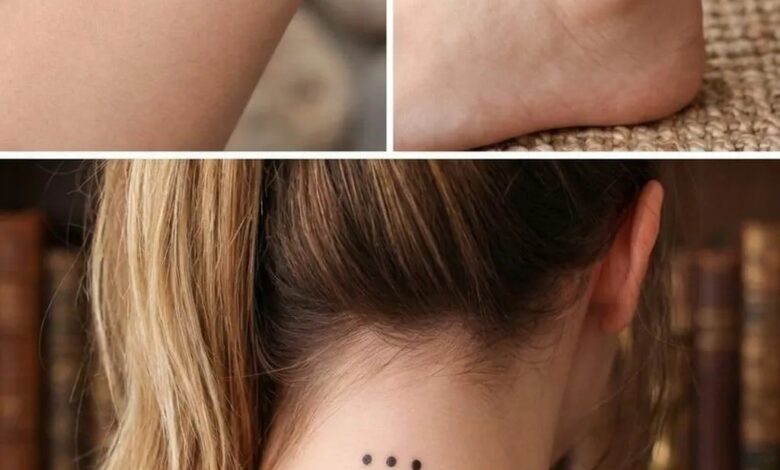
At first glance, a three-dot tattoo might seem almost too simple to carry meaning. It’s small, minimal, and often placed in subtle areas—on the hand, between the thumb and index finger, along the knuckles, or near the eye. But like many symbols that endure over time, its simplicity is exactly what allows it to hold depth. Behind those three dots lies a range of interpretations shaped by culture, personal experience, and the environments in which it appears.
One of the most widely recognized meanings associated with the three-dot tattoo is tied to the concept of the “Three Wise Monkeys.” This idea—“see no evil, hear no evil, speak no evil”—has been passed through generations as a representation of restraint and awareness. In this context, the tattoo reflects a personal philosophy: a choice to avoid negativity, to remain silent in the face of conflict, or to live with a sense of internal discipline. It becomes less about what is shown and more about what is intentionally withheld.
For some individuals, this interpretation resonates as a quiet code for how they navigate the world. It suggests control, discretion, and the understanding that not everything needs to be seen, heard, or spoken. In a culture where expression is often constant and immediate, this meaning stands in contrast—emphasizing thoughtfulness over reaction.
At the same time, the three-dot tattoo carries different meanings in other contexts. In certain communities, it has been linked to ideas of loyalty, unity, and shared identity. It can act as a subtle signal among those who recognize it, representing a connection that does not require explanation. In these cases, the tattoo becomes less about individual philosophy and more about belonging—about being part of something defined by shared experiences or values.
This sense of connection often extends to personal history.
For many people, the three-dot tattoo is not chosen for its widely known meanings, but for what it represents in their own lives. It can mark a period of hardship, a turning point, or a journey that required resilience. The three dots may symbolize phases of life—past, present, and future—or the idea that life is ongoing, unfinished, and still evolving.
In some interpretations, it is associated with the phrase “my life, my journey.” This meaning highlights individuality and personal agency, emphasizing that each person’s path is unique. The simplicity of the design allows it to carry this message without the need for elaborate imagery. It becomes a reminder that even small symbols can represent complex experiences.
Cultural differences also play a significant role in how the tattoo is understood.
In one region, it may be seen as a philosophical statement. In another, it may be tied to specific social groups or environments. These variations demonstrate how symbols adapt as they move across different contexts. What remains consistent, however, is the idea of expression—of using a simple visual form to communicate something deeper.
This adaptability is part of what gives the three-dot tattoo its longevity. Unlike more detailed designs that may be tied to a specific time or trend, its minimalism allows it to remain relevant while taking on new meanings. It does not demand attention, but it invites interpretation.
That said, the visibility of such tattoos can sometimes lead to misunderstanding.
Because the three-dot tattoo has been associated with different groups and environments, people may form assumptions based on limited knowledge. In some cases, it has been linked to certain subcultures or lifestyles, leading to interpretations that do not reflect the individual’s actual intent. This highlights a broader issue—how quickly meaning can be assigned without context.
A symbol, no matter how simple, is rarely one-dimensional.
What it represents depends on who carries it, where it appears, and the experiences behind it. For one person, the three dots may signify discipline and restraint. For another, they may represent survival and personal growth. For someone else, they may simply be a reminder of a specific moment or connection.
Understanding this requires a level of openness.
It means recognizing that symbols do not exist in isolation—they are shaped by the stories attached to them. Judging them without that context can lead to conclusions that overlook the individuality they are meant to express.
The placement of the tattoo can also influence its meaning.
When located on the hand, it is often visible, suggesting a willingness to carry that meaning openly. When placed in less noticeable areas, it may hold a more private significance, something meant for the individual rather than the world. This choice reflects how people balance personal expression with public perception.
In many ways, the three-dot tattoo represents a broader idea about communication.
Not all messages need to be complex to be meaningful. Sometimes, the most powerful expressions are the ones that require interpretation, that invite curiosity rather than provide immediate answers. The three dots do not tell a complete story on their own—they suggest one.
They leave space.
Space for meaning to be added, for experiences to be layered, for identity to be shaped over time.
This is part of what makes the tattoo enduring. It does not limit the person who wears it. Instead, it evolves with them, taking on new significance as their life changes. What it represents at one point may shift as new experiences are added, making it a living symbol rather than a fixed one.
In the end, the three-dot tattoo is more than a design.
It is a reflection of how people choose to represent themselves—quietly, minimally, but with intention. It shows that meaning does not always require complexity, and that even the smallest marks can carry depth.
Whether seen as a philosophy, a connection, or a personal reminder, it serves as evidence that identity can be expressed in many forms. And sometimes, the simplest forms are the ones that last the longest, not because they demand attention, but because they continue to hold meaning long after they are first created.