The photographer recognized he had captured something unique after taking this picture!
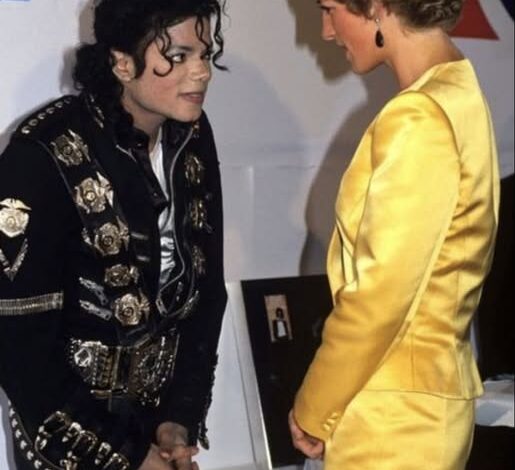
There is a photograph taken in the summer of 1988 that continues to fascinate people decades later. In it, Princess Diana stands beside Michael Jackson backstage at Wembley Stadium. At first glance, it appears to be a simple meeting between two global icons—one royalty by birth, the other royalty by talent. But the more you learn about that night, the more layered the story becomes.
Neither Diana, Princess of Wales, nor Michael Jackson requires much introduction. By the late 1980s, both were among the most recognized faces on the planet. Diana had become known as “The People’s Princess,” admired for her warmth, compassion, and willingness to connect with ordinary citizens. Michael Jackson, already crowned the King of Pop, was breaking records, redefining music videos, and commanding stadiums filled with tens of thousands of fans.
Their worlds seemed different—one rooted in monarchy, the other in entertainment—but both understood what it meant to live under relentless scrutiny.
They met in person only once. The date was July 16, 1988. Diana and her then-husband, Prince Charles, attended Jackson’s Bad tour concert at Wembley Stadium in London. The event was organized in part to support the Prince’s Trust charity, and Jackson had already made substantial donations to charitable causes in the United Kingdom, including funds for Great Ormond Street Hospital.
Backstage before the concert, the two were introduced. Michael later recalled feeling deeply nervous about meeting Diana. Despite performing for massive crowds around the world, the idea of greeting a princess left him tense. In photographs from that evening, there is a visible stiffness in his posture and a kind of cautious politeness between them.
Part of that awkwardness stemmed from a decision Jackson had made before the show. Out of respect, he had removed the song “Dirty Diana” from the setlist. The track, which tells the story of a persistent groupie, seemed inappropriate to perform in front of a royal guest who happened to share the same name. Jackson believed omitting the song was the proper thing to do.
But Diana surprised him.
During their conversation before the concert, she reportedly asked whether he would be performing “Dirty Diana.” When he explained that he had taken it out of the show in her honor, she encouraged him to put it back in. She wanted him to perform the full concert as intended. With her approval, Jackson restored the song to the setlist and performed it that night.
The exchange revealed something about Diana’s character. She was not fragile or easily offended, as tabloids often suggested. She was, in fact, a devoted music fan. Her favorite band was said to be Duran Duran, but she also loved Jackson’s music. Albums like Thriller and Bad were reportedly part of her personal collection. During the Wembley concert, witnesses later claimed she danced enthusiastically in her seat, while Prince Charles remained more reserved.
That single meeting may have been brief, but it appears to have left a lasting impression on both of them.
In later interviews, Jackson spoke warmly about Diana. He described her as kind and gracious, someone who understood the pressures of public life in a way few others could. According to Jackson, they maintained contact by phone in the years that followed. He claimed that Diana would sometimes call late at night and that they spoke at length about their children and the challenges of media intrusion.
Some of those claims have been questioned by individuals close to Diana, who suggested that palace protocols would have made such direct communication unlikely. Regardless of the exact details, it is clear that Jackson felt a connection to her.
What bound them most closely was their shared experience with the press. Both were pursued relentlessly by paparazzi. Every outfit, every friendship, every facial expression became headline material. Privacy was nearly nonexistent. They lived in a world where even the smallest misstep could explode into scandal.
Jackson’s former bodyguard later suggested that the singer admired Diana deeply, even describing his feelings as love. Whether that sentiment was romantic or simply emotional admiration is open to interpretation. What seems undeniable is that Jackson believed Diana was one of the few people who truly understood the isolation that fame can bring.
Their common ground extended beyond media struggles. Both were committed to humanitarian causes. Diana’s work with AIDS patients, landmine victims, and vulnerable children redefined public expectations of royalty. Jackson, for his part, donated millions to charities worldwide and frequently incorporated messages of unity and compassion into his music.
Tragically, their lives would both end prematurely.
When Diana died in a car crash in Paris in August 1997, the world was stunned. According to reports, Jackson was devastated when he learned of her death. Some accounts claim he fainted upon hearing the news and had to be revived. He postponed a concert performance on his HIStory tour, saying he was too shaken to go on stage.
When he eventually returned to performing, he paid tribute to her, calling her “the true princess of the people.” His words echoed the sentiments of millions who mourned her loss.
Jackson attended a memorial service in Los Angeles, dressed in black with his trademark fedora. In later interviews, he continued to speak fondly of Diana, describing her as one of the sweetest people he had ever known and emphasizing the bond they shared over the burdens of fame.
Looking back at that single photograph from 1988, it captures more than a polite backstage introduction. It freezes a moment where two of the most photographed individuals in history stood side by side, united by circumstance, fame, and vulnerability.
The photographer who pressed the shutter likely had no idea how symbolic the image would become. At the time, it was simply a meeting between a princess and a pop star. In hindsight, it represents the intersection of two extraordinary lives—both luminous, both complicated, both gone too soon.
That picture remains powerful not just because of who they were, but because of what it hints at: two people who, beneath titles and headlines, may have found a rare understanding in one another.