The Secret of the Miller Creek Trapdoor
Ethan Walker’s life was a series of grinding gears and missed opportunities. On a humid Kentucky morning that felt heavy with the scent of impending rain and stale courthouse coffee, he sat in a cramped conference room to hear the final wishes of a man who had been a ghost to him for years. Walter “Walt” Walker had been a stern, silent figure, a grandfather who had largely retreated into the shadows of the Appalachian foothills after Ethan’s father passed away. Now, Walt was gone, leaving behind a legacy that the rest of the family viewed with a mixture of greed and ridicule.
Across the table, the atmosphere was thick with unspoken tension. Ethan’s aunt Carol and her husband Donnie were dressed in their Sunday best, their eyes darting toward the old lawyer, Mr. Abernathy, as if he were holding the winning ticket to a lottery they felt they deserved. Behind them, Ethan’s cousin Mason leaned back with a smug grin, already counting the imaginary bills in his head. Ethan, by contrast, felt out of place. He wore a button-down shirt that pinched his shoulders and boots stained with the indelible grease of the Lexington garage where he worked odd shifts. He hadn’t come for an inheritance; he had come out of a sense of obligation to a name he barely knew.
The reading of the will went exactly as the room expected. Carol was granted the farmhouse. Donnie inherited the reliable old truck. Mason received the bank account, though his grin faltered significantly when Abernathy revealed the balance was a mere four thousand dollars. Finally, the lawyer peered over his spectacles at Ethan, his voice crackling like dry parchment. He announced that Ethan was the sole heir to a structure known as the Miller Creek shack, along with its contents and the small strip of land surrounding it.
The room erupted into laughter. Mason didn’t even try to hide his derision, calling it a rotten utility shed that wasn’t fit for a lawnmower. Carol offered a pitying smile, remarking that her father always had a cruel sense of humor. Ethan felt the heat of embarrassment crawl up his neck. He signed the documents in a daze, took the yellowed deed, and walked out into the cold rain. He was a property owner, but to everyone else, he was the recipient of the family joke.
For the next six months, the shack remained a distant thought. Ethan’s life continued its downward spiral. The garage cut his hours, his landlord increased the rent on his tiny room behind a laundromat, and his own truck began to fail him. Throughout this struggle, the folder from the lawyer sat on his passenger seat like a silent taunt. Mason called him twice, first offering five hundred dollars and then a thousand to take the “eyesore” off Ethan’s hands. Mason tried to sound like he was doing a favor, but there was a hungry edge to his voice that made Ethan hesitate. He wasn’t sure why he said no, but he did.
When the laundromat owner finally evicted him to make room for a returning relative, Ethan found himself at a crossroads. With his life packed under a tarp in the bed of his truck, he sat in the glow of a gas station light and read the deed one more time. A specific phrase caught his eye: “all contents and improvements, visible and concealed.” The word “concealed” stuck in his mind. He realized he had nothing left to lose and a curiosity he couldn’t quiet.
The drive to Miller Creek was a journey through a forgotten world. The road narrowed into a rutted path choked by weeds and low-hanging branches that clawed at his truck. When he finally reached the clearing, the shack looked even worse than the descriptions. It leaned precariously to one side, its tin roof curling like dead leaves, and the porch was a heap of splintered timber. It looked like a stiff breeze would return it to the earth.
Ethan broke the ancient padlock with a crowbar and forced the door open against a stubborn resistance. Inside, the air was stagnant, smelling of dust and old newspapers. The shack was a graveyard of junk—broken fishing poles, rusted stoves, and crates of glass jars. At first glance, it was exactly the worthless pile of trash Mason had promised. But as Ethan moved through the shadows, he noticed something peculiar. Amidst the chaos of the debris, a square area in the center of the floor had been kept remarkably clear of the heavy dust that coated everything else.
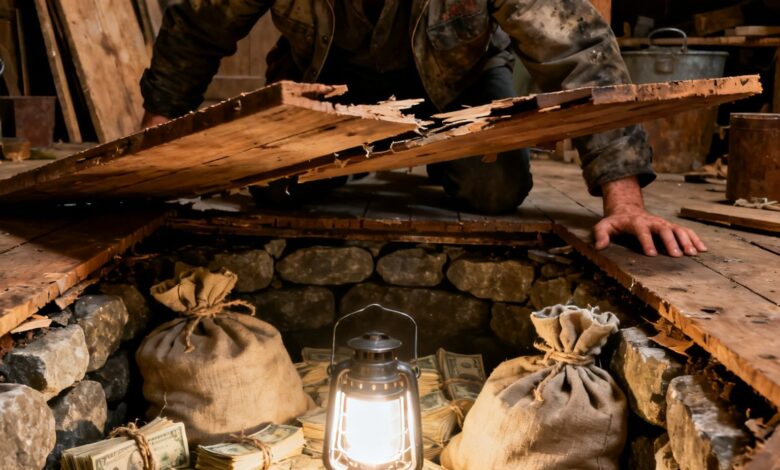
He pulled back a tattered rug to reveal a trapdoor flush with the floorboards. His heart hammered against his ribs as he gripped the recessed iron ring. It took every ounce of strength he possessed, his muscles screaming under the strain, but the heavy wood eventually gave way with a thunderous crack. Instead of the expected smell of rot or damp soil, a scent of cedar and dry, preserved air drifted up from the darkness.
Ethan clicked on his flashlight and descended a narrow set of wooden stairs. The space beneath the shack was not a cellar but a meticulously reinforced vault lined with cedar planks. As the beam of light swept across the room, it landed on a series of heavy industrial trunks and several long, slender wooden crates. He opened the first trunk and gasped. It wasn’t gold or cash, but something far more unexpected: a massive collection of pristine, hand-tooled leather journals and hundreds of rolls of high-quality architectural blueprints and maps.
As he began to flip through the journals, the true secret of the Walker family emerged. His grandfather hadn’t been a simple hermit; he had been a master surveyor and a silent partner in several of the region’s largest land acquisitions during the coal and timber booms of the mid-twentieth century. The journals contained meticulous records of land rights, unmapped mineral veins, and, most importantly, legal documents proving the family still held “subsurface rights” to thousands of acres of what was now protected state forest and private corporate land.
Tucked between the pages of the final journal was a letter addressed specifically to Ethan. In it, Walt explained that he had watched his children grow into people consumed by immediate greed, and he knew they would sell the family’s future for a quick payout. He had chosen Ethan because he saw a quiet resilience in the boy—a trait the others lacked. The “worthless” shack was a test and a sanctuary, holding the keys to a fortune in royalties and land claims that had been legally buried for decades.
Ethan sat on the floor of the vault, surrounded by the weight of his new reality. The shack wasn’t a joke; it was a fortress protecting a legacy. He looked up at the sagging ceiling and realized that for the first time in his life, he wasn’t just surviving. He was standing on a foundation that was deeper and stronger than anyone could have imagined. The man who had inherited a “worthless” shack was now the most powerful man in the county, and he hadn’t even begun to explore the rest of the crates.