THE SILENT THREAT IN YOUR MOUTH: Why That Small, Painless Bump Could Be a Time Bomb
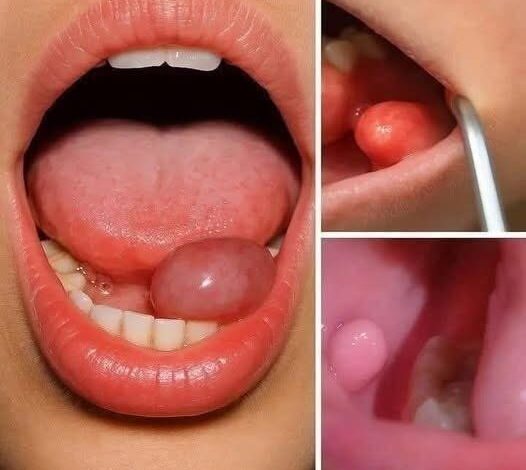
You reach into your mouth, your finger brushing against a small, smooth lump you’ve never noticed before. It doesn’t hurt. It doesn’t itch. You tell yourself it’s just a scratch from a crusty piece of bread or a minor irritation that will vanish by morning. But what if you’re wrong? The oral cavity is a complex landscape that serves as the first line of defense for your entire body, and it often screams for help long before you feel any pain. That innocent-looking bump could be a harmless nuisance, or it could be a terrifying, early signal of something far more sinister.
We are conditioned to equate illness with pain, but the most dangerous conditions often begin in total silence. A small lump or growth inside your mouth can easily be dismissed as a consequence of everyday life—an accidental bite while eating, a reaction to a sharp tooth, or a blocked salivary gland. However, when these abnormalities persist, they cross the threshold from a minor annoyance into a significant health concern. Dental professionals and healthcare experts are unanimous in their advice: any lesion that does not show signs of healing within two weeks is not just a passing irritation—it is a medical mystery that demands an immediate, professional explanation.
The anatomy of your mouth is exceptionally sensitive, making it a highly accurate barometer for your systemic health. Small changes in the texture, color, or shape of your oral tissues are often the very first signs of trouble. While it is true that many of these growths are benign, the danger lies in the assumption of safety. A common culprit is the mucocele, a soft, fluid-filled swelling that occurs when a salivary gland becomes blocked or damaged. These appear as smooth, sometimes transparent bubbles, and while they frequently resolve on their own, their persistence can mimic more aggressive conditions. Similarly, chronic irritation from dental appliances or the persistent friction of a sharp tooth can lead to the formation of fibromas—benign tissue growths that will continue to expand as long as the source of trauma remains present.
However, it is the lesions that don’t fit these easy explanations that should trigger your alarm. You must be vigilant for symptoms that extend beyond the mere presence of a lump. Are you experiencing unexplained bleeding in the mouth? Does it feel like something is caught in your throat when you swallow? Is there an area of your mouth that has developed a persistent white or red patch, or a patch of tissue that feels thickened and leathery? These are not “normal” variations. Even if the area is completely painless, the lack of discomfort is not a guarantee of health. In fact, many serious oral health issues are insidious specifically because they progress without the warning signal of pain, allowing them to gain a foothold before you even realize a problem exists.
The two-week rule is the golden standard for oral safety. If you discover a change in your mouth and it remains unchanged for fourteen days, you must bypass the internet’s forums and head straight to a dentist or physician. Early detection is the most powerful tool in modern medicine; it is the difference between a simple, minimally invasive procedure and a complex, life-altering battle. By the time many patients finally seek care, they have spent weeks or months hoping the condition would simply “go away,” often allowing a treatable issue to evolve into a serious medical emergency.
Taking control of your oral health requires more than just brushing and flossing; it requires active surveillance. You should conduct regular self-examinations, taking the time to feel and look at the gums, the tongue, the roof of the mouth, the cheeks, and the floor of the mouth. Use a bright light and a mirror. If you see something that looks out of place, don’t wait for your next scheduled checkup. Professional evaluation is the only way to obtain definitive answers and the peace of mind that comes with knowing exactly what is happening in your body.
Furthermore, consider the lifestyle factors that contribute to the integrity of your oral tissues. Tobacco and excessive alcohol consumption are known to significantly degrade the health of your mouth, creating an environment where abnormal cells are more likely to thrive. Conversely, a diet rich in fruits, vegetables, and essential vitamins supports the immune system and the health of your mucous membranes, potentially acting as a protective buffer against oral disease. While nutrition is not a cure-all, it is a foundation upon which your health is built.
Ultimately, the goal is not to live in fear of every minor bump, but to cultivate a sense of informed responsibility toward your health. Your mouth is a window into your well-being, providing valuable, often early, warnings that can save your life if you are willing to pay attention. Most oral lumps are indeed harmless, and most are easily corrected once diagnosed, but you must act with the assumption that your body is telling you something important. When you choose to get a professional opinion, you are not just checking on a lump—you are investing in your long-term health and preventing a minor change from becoming a major crisis. Stop waiting for the symptoms to become unbearable. Listen to the small signs today, so you don’t have to face the larger consequences tomorrow.