My 8 Year Old Has Had This for 2 Months, and It’s Getting Worse What Could It Be?
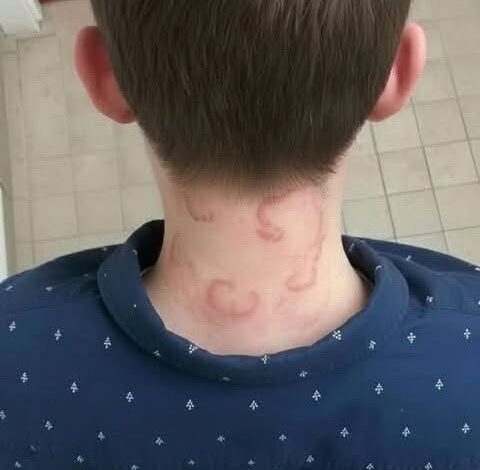
Seeing an unusual rash on your child can be worrying, especially when it doesn’t disappear after a few days.
A small patch of irritated skin may be caused by something as simple as friction, dryness, or an allergic reaction. But when red or irritated areas continue for weeks, spread, change, or become more noticeable, parents naturally start wondering whether something more serious could be happening.
The image above shows several reddish, ring-like marks across the back of a child’s neck. A photograph alone cannot determine what caused them, and several different skin conditions can produce similar-looking changes.
Because the symptoms have reportedly lasted for around two months and are getting worse, this is the kind of situation that deserves an evaluation by a pediatrician or dermatologist, rather than relying on a home diagnosis.
Here are some possibilities doctors may consider and some important things parents can watch for.
Many minor childhood rashes improve relatively quickly.
A temporary reaction to heat, sweat, a new soap, or an insect bite may disappear within days once the trigger is removed.
A rash that continues for weeks or repeatedly returns, however, may have a different underlying cause.
Persistent skin changes can sometimes be associated with:
Irritation or repeated friction
Allergic or contact reactions
Eczema
Fungal infections
Hives or other inflammatory reactions
Certain viral or bacterial conditions
Inflammatory skin disorders
Reactions to medications or personal-care products
The appearance of a rash can provide clues, but appearance alone usually isn’t enough to identify the cause confidently.
That’s particularly important in children because several unrelated conditions can look surprisingly similar.
One possibility doctors may consider when they see circular or ring-shaped patches is a superficial fungal infection such as tinea corporis, commonly known as ringworm.
Despite its name, ringworm isn’t caused by a worm.
It’s caused by fungi that live on the outer layers of the skin.
A typical lesion may begin as a small area and gradually expand outward. Some cases develop a more noticeable border, while the center may look relatively clearer.
The rash can sometimes be:
Itchy
Scaly
Circular
Raised around the edges
Slowly expanding
However, not every ring-shaped rash is ringworm.
That’s why treating based solely on a photograph can be misleading.
If a clinician suspects a fungal infection, they may examine the skin closely and, in some cases, perform a simple skin scraping or other test.
The neck is exposed to many potential irritants.
A child’s skin may come into contact with:
Shirt collars
Laundry detergent
Fabric softener
Perfume
Hair products
Sunscreen
Shampoo
Body wash
Sweat
Jewelry or accessories
If something repeatedly contacts the same area, the skin can become irritated.
This type of reaction may produce redness, itching, dryness, scaling, or small bumps.
Sometimes the trigger isn’t obvious because the child has been exposed to it for months.
For example, a family might switch laundry products without realizing that the new product is irritating sensitive skin.
Children are active.
They run, play sports, sweat, wear backpacks, and spend time outdoors.
The neck can become particularly vulnerable to heat, moisture, and friction.
A shirt collar or backpack strap may repeatedly rub against the same area.
Sweat can also remain trapped against the skin, especially during hot weather.
Even when friction isn’t the original cause of a rash, it may make an existing skin problem more uncomfortable or noticeable.
Keeping the area clean and dry and choosing loose, breathable clothing may help reduce irritation while waiting for professional evaluation.
Eczema is another common possibility when a child experiences persistent itchy or irritated skin.
Although many people associate eczema with dry, rough patches, it doesn’t always look identical.
Depending on the child’s age, skin tone, location, and stage of inflammation, eczema can appear as:
Red or darker patches
Dry skin
Scaling
Small bumps
Cracked skin
Thickened skin from repeated scratching
The neck can be affected, particularly in children who are prone to sensitive skin.
A doctor may consider the child’s personal history, family history, other affected areas, and symptoms such as itching when evaluating whether eczema is involved.
Hives, or urticaria, can cause raised, itchy areas that appear suddenly.
They can sometimes have unusual shapes and may merge together, creating patterns that look quite dramatic.
But typical hives are temporary.
Individual welts generally disappear or move within hours rather than remaining in exactly the same place for weeks.
That’s why a rash that remains visible in the same areas for two months isn’t something that should automatically be labeled as hives.
A doctor can help distinguish temporary urticaria from other conditions that produce longer-lasting lesions.
Sometimes the answer isn’t a disease at all.
The skin may simply be responding to something the child regularly encounters.
Think about recent changes involving:
Laundry products:Did the family switch detergent, fabric softener, or stain remover?
Personal-care products:Has the child started using a different shampoo, soap, conditioner, or lotion?
Clothing:Is there a new uniform, sports jersey, scarf, or collar rubbing against the neck?
Sports equipment:Does a helmet strap, protective gear, or backpack regularly touch the affected area?
Outdoor exposure:Has the child been spending more time around grass, plants, animals, or swimming pools?
These details may seem insignificant, but they can be extremely useful to a healthcare professional.
Children don’t always realize how much they scratch.
An itchy patch can lead to repeated rubbing or scratching, which may cause additional redness and irritation.
Over time, the skin can become thicker or develop small abrasions.
This creates a frustrating cycle:
Itching → scratching → irritation → more itching.
Keeping fingernails short can reduce accidental skin damage.
Parents can also encourage children to avoid scratching as much as possible, although this can be difficult when the underlying condition is very itchy.
The key is to address the cause of the itching, rather than simply focusing on the scratching.
The fact that the marks are concentrated around the neck is useful information.
Doctors don’t look only at what a rash looks like.
They also consider where it appears.
Certain conditions have characteristic distributions.
For example, a rash concentrated beneath a clothing line may suggest irritation or contact exposure, while a rash affecting multiple unrelated areas may point toward a different process.
That’s why parents should mention whether similar marks are present on:
The arms
Legs
Chest
Back
Face
Scalp
Hands
Feet
The distribution can provide important clues.
One of the simplest questions to ask a child is:
Itching can provide useful information.
Some skin conditions are extremely itchy, while others cause little or no discomfort.
Also ask whether the area:
Burns
Hurts
Feels warm
Feels dry
Feels rough
Becomes worse after sweating
Becomes worse at night
Children may describe symptoms differently from adults, so simple questions can help parents understand what’s happening.
Taking a photograph every few days can be surprisingly useful.
Try to take pictures under similar lighting and from approximately the same distance.
This creates a visual record showing whether the areas are:
Expanding
Fading
Becoming darker
Becoming more raised
Developing scaling
Appearing in new locations
A doctor may find this history helpful, particularly if the rash changes between appointments.
Avoid using filters or heavy editing because they can alter the appearance of the skin.
It’s very common to hear:
“It must be an allergy.”
But many different conditions can cause red or irritated skin.
An allergy is only one possibility.
Fungal infections, eczema, irritation, insect exposure, inflammatory conditions, and other causes can produce overlapping symptoms.
That’s why repeatedly applying different creams without knowing the cause can sometimes make the situation more confusing.
This is particularly important when a rash could potentially be fungal.
Topical corticosteroids can reduce inflammation and itching in certain conditions, but they aren’t appropriate for every rash.
Using a steroid cream on an undiagnosed fungal infection can sometimes change its appearance and allow the infection to persist or spread, making diagnosis more difficult.
That doesn’t mean steroid medications are bad.
They can be very useful when prescribed or recommended appropriately.
The issue is using them blindly on an unexplained rash.
For a persistent childhood rash, it’s better to ask a healthcare professional or pharmacist what treatment is appropriate.
A rash that has persisted for approximately two months is already a good reason to arrange a medical evaluation.
Parents should be particularly attentive if the rash:
Continues spreading
Keeps returning
Becomes increasingly itchy
Causes pain
Develops significant swelling
Produces blisters
Becomes crusted or infected-looking
Is associated with hair loss
Appears in multiple areas
Interferes with sleep
Doesn’t improve after removing a suspected irritant
A pediatrician can examine the child and determine whether referral to a dermatologist or additional testing is appropriate.
Most childhood rashes aren’t emergencies.
However, certain accompanying symptoms warrant prompt medical attention.
Seek urgent medical care if a child develops a rash along with:
Difficulty breathing
Swelling of the lips, tongue, or throat
Fainting or severe weakness
A rapidly spreading rash with significant illness
High fever and a child who appears very unwell
Purple or dark red spots that don’t fade when pressed
Severe pain
Extensive blistering or skin peeling
The combination of a rash with serious systemic symptoms is more concerning than an isolated, stable skin change.
There are several low-risk steps that may help protect irritated skin.
Use gentle cleansing and avoid aggressive scrubbing.
Choose mild, fragrance-free products when possible.
Especially after sweating or physical activity.
Soft, breathable fabrics may reduce friction around the neck.
Scratching can damage the skin and potentially introduce bacteria.
Applying several different creams at once can make it difficult to determine what’s helping or worsening the condition.
A visual timeline can help the doctor understand how the rash has changed.
Before the appointment, it can help to write down a few details.
Consider noting:
When did it first appear?
Where did it start?
Has it spread?
Does it itch or hurt?
Is it worse after sweating?
Has anything changed at home?
Any new soaps, detergents, clothing, or medications?
Does anyone else in the household have a similar rash?
Has the child been around pets or animals?
Has the child recently participated in sports or swimming?
These seemingly small details can help narrow down the possibilities.
The image can certainly raise questions, but skin diagnosis often depends on information that a photograph can’t provide.
A clinician may need to know:
How the lesions feel
Whether they’re raised
Whether they scale
Whether they blanch when pressed
How quickly they change
Whether new lesions appear
Whether the child has other symptoms
Whether there are affected areas elsewhere
Sometimes a clinician can identify a condition based on appearance and history alone.
Other times, testing may be necessary.
That’s why online images should be used as a reason to ask better questions, not as a substitute for medical evaluation.
A persistent rash doesn’t automatically mean something dangerous.
Children develop many skin problems, and the majority have manageable explanations.
At the same time, a rash that has lasted for two months and is reportedly getting worse shouldn’t simply be ignored.
The best approach is somewhere between panic and dismissal:
Stay calm, observe carefully, and get the child properly evaluated.
When you see unusual marks on a child’s skin, it’s natural to search for answers online.
But skin conditions can be deceptive.
A circular patch might be fungal.
A red patch might be irritation.
An itchy area might be eczema.
A raised mark might be an inflammatory reaction.
And sometimes two completely different conditions can look remarkably similar.
Only an appropriate medical evaluation can determine what’s actually happening.
If an 8-year-old has had a worsening skin change for two months, arranging an appointment with a pediatrician or dermatologist is a sensible next step.
Until then, avoid scratching, minimize potential irritants, keep the skin comfortable, and document how the affected areas change.
Most importantly, don’t let a frightening-looking photograph convince you that you already know the diagnosis.
The appearance of a rash can provide clues—but the full story matters much more.