The Golden Boy and the Shadowed Sister: The Day My Father’s Love Finally Showed Me His True Colors
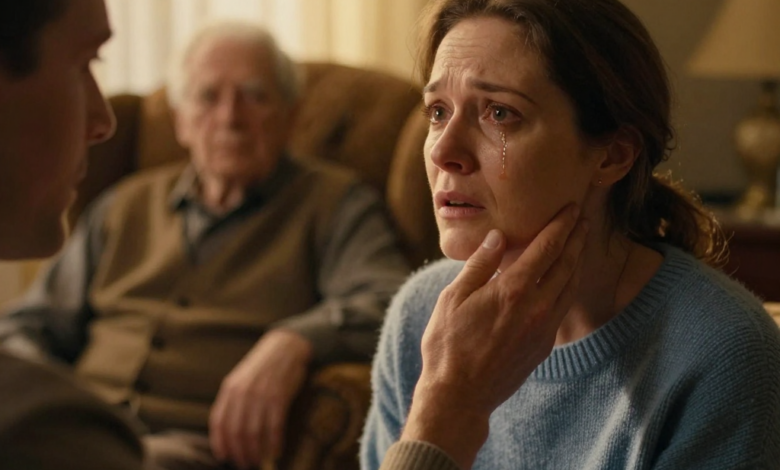
The aroma of scorched sugar and cinnamon—that was the scent of my childhood. It clung to the worn velvet curtains of our suburban living room, seeped into the fibers of the heirloom rug, and became inextricably linked with the memory of my father’s booming laughter. For twenty-seven years, that laughter had been a constant, warm solar flare in the otherwise predictable orbit of our family life. Me—Elara—I was the quiet satellite. My brother, Julian, was the blazing sun.
From the moment we were toddlers, it was an open secret, a tangible current running through every shared meal and whispered argument: Dad favored Jules. It wasn’t malice; it was something deeper, more ingrained, perhaps genetic. Julian possessed the effortless grace that made him look good even while wrestling with a pile of laundry. He spoke with a resonant timbre that commanded attention in any room, whether he was recounting a mediocre high school football victory or debating astrophysics over dinner. I, on the other hand, was built for the background—observant, meticulous, and painfully introverted. My achievements, though steady and undeniable (the perfect report card, the lead role in the local community theater production, the quiet excellence of my coding projects), felt like polite applause compared to Julian’s thunderous ovation.
“Elara-bug,” he’d call me, his voice laced with a condescending sweetness that always made my chest tighten, “You’re so wonderfully… *reliable*. Like a well-oiled clock. But where is the spark? Where is the fire, sweetheart?”
Julian, meanwhile, was perpetually ablaze. He chased glory like it was an addictive drug. If he couldn’t be the top student, he’d be the captain; if not the captain, he’d be the most charismatic guy in the cheering section. His ambition wasn’t just a drive; it felt like his very oxygen supply. Our mother, bless her pragmatic soul, would smooth things over with well-timed casserole deployments and knowing glances, but even she seemed to lean marginally toward Julian when deciding who deserved the front seat of the family minivan.
My own internal monologue was a perpetual symphony of ‘should haves’ and ‘what ifs.’ Why wasn’t my artistic passion—the moody, intricate landscape painting that felt like pouring my entire nervous system onto canvas—enough? Was it because Julian painted sunsets with an almost arrogant proficiency, making mine look merely competent? I internalized the comparison until the distinction between his light and my shadow felt less like a difference and more like a cosmic injustice.
The dynamic was suffocatingly comfortable. Holidays were staged events where Dad would invariably direct conversation toward Julian’s latest conquest. Birthday parties revolved around Jules’ ridiculously expensive, often impractical gifts. When I received an accolade—a regional art prize that actually meant something to me—Dad would smile, pat my shoulder with a gesture that felt both affectionate and dismissive, before immediately pivoting: “…but listen to what Julian did last week! He secured the lead role at the summer festival! Now *that’s* ambition!”
I started retreating further into my shell. My responses became shorter; my ambitions, quieter. The vibrant colors in my paintings began leaning toward muted blues and deep forest greens, reflecting my own internal palette of quiet endurance.
Then came the illness. It wasn’t sudden or dramatic like a cinematic ambush; it was slow, insidious, like groundwater eroding bedrock. First, the fatigue. Then, the shaky hands that used to wield the carving knife with such confident precision. Finally, the periods of silence—long, frightening stretches where Dad would simply stare out the window, his usual booming presence dimmed by an opaque haze.
We called it a decline. We prepared for the inevitable, setting up his favourite reading chair in the sunniest spot, ensuring all his prized memorabilia was dust-free and ready for adoration. Julian, naturally, threw himself into the role of Chief Caregiver Alpha. He organized shifts, researched pain management techniques with obsessive fervor, and spoke to Dad with a mixture of fierce protectiveness and genuine awe. Mom hovered, worried about her own diminishing energy reserves. Me? I was the shadow support system—making sure his water glass was never empty, smoothing wrinkles from his favourite linen shirts, quietly running errands.
Julian started slipping into a routine that felt too perfect. He managed Dad’s needs with such dazzling competence that it seemed to validate every expectation Dad had ever held for him. “See, Elara? This is what happens when you apply yourself,” Julian would murmur, leaning close as Dad rested his head against the cushion. “You don’t just *exist*; you achieve.”
It was during one of these routine check-ins—late Tuesday afternoon, the golden hour light filtering through the lace curtains, bathing Dad in a melancholic amber glow—that it happened. Dad had been unusually subdued, his breathing shallow and patterned, like a dying bellows. Julian was recounting an anecdote about a particularly grueling rehearsal for his new play, complete with perfectly timed inflection pauses.
“…and so,” Julian finished, pausing to watch the soft movement of Father’s jaw, “he looked up at me, Elara, and said, ‘My boy, you are everything. A magnificent symphony.'”
Julian beamed, a triumphant supernova of a smile. I felt the familiar prickle behind my eyes, readying for the expected surge of pride—the one that always seemed to eclipse mine.
But Dad didn’t look at Julian. He turned his gaze, slow and heavy, until it settled directly on me. My breath hitched. It was a different kind of look than Julian usually received; it wasn’t just praise, it felt like *recognition*. Deep, profound, almost desperate recognition.
Dad opened his mouth, and the sound that emerged wasn’t a booming declaration, nor was it a tired mumble. It was raspy, fragile, yet utterly piercing. “Elara…”
Julian’s smile faltered, replaced by a questioning furrow in his brow. Mom leaned forward instantly, concern etching lines around her mouth.
Dad squeezed my hand, the skin papery and cool beneath my palm, and struggled to force out the next words. They were labored, punctuated by shuddering intakes of breath, but they landed with the undeniable weight of absolute truth.
“Julian… is the song. He shines so bright… so loud.” Dad managed, his eyes fluttering shut momentarily, as if gathering the immense energy required for this confession.
Then, the true blow landed. The sentence that fractured the carefully constructed narrative of our family life.
“But you, my quiet star… Elara. You are the foundation. You are… the anchor. The one who doesn’t need to be seen to hold everything up.” He paused again, and a single, crystalline tear traced a path down his withered cheek.
“You… you *are* the marrow of this family, my girl. Julian is the fanfare. But you… you are the breath itself.”
Silence descended. The sound of the distant lawnmower seemed impossibly loud. Julian stood frozen mid-gesture, his brilliant expression shattering into something raw—a complex mixture of surprise, hurt, and perhaps a sudden, stinging vulnerability he rarely allowed himself to show.
I stared at my father, not hearing the words anymore, but feeling them reverberate through my bones. The years of comparison, the quiet resentment simmering beneath the surface of every polite interaction, all the times I’d felt like an impressive footnote while Julian was the main headline—it evaporated in that single moment.
He hadn’t just *preferred* him; he had elevated him to a radiant idol. But what he saw in me wasn’t mere competence or quiet grace. He saw necessity. He saw substance. He saw the unshakeable, necessary core of his world.
Julian finally moved. He didn’t rush forward with triumphant fanfare; instead, he slowly sank onto the edge of Dad’s chair, his usual posture of effortless superiority momentarily dissolving. His face was unreadable—a perfect mask cracking just enough to reveal the shock beneath.
“The anchor? But… Elara, you never ask for it,” Julian managed, his voice lower than its usual ringing tone, stripped bare of its performance quality. It sounded… needy.
Dad offered a weak nod, a gesture that spoke volumes more than any sentence could.
Mom finally broke the spell with a gentle, choked sob, reaching out to stroke Dad’s hair. “Oh, my love…” she whispered.
But it was Julian who looked at me then. He looked past the muted watercolors of my soul, past the quiet deference in my posture, and into the steady, unwavering light that defined *me*. And for the first time, he didn’t look at me with paternalistic admiration; he looked at me with a sudden, dawning sense of… inadequacy.
The weight of his confession settled heavily upon me. It wasn’t just relief, though there was plenty of that. It was a seismic shift in my understanding of love, achievement, and worth. Dad hadn’t just finally acknowledged me; he had fundamentally redefined my place in the hierarchy of his heart. The fanfare didn’t mean you were less valuable than the foundation; it meant the foundation *allowed* the fanfare to exist.
As Dad’s grip loosened slightly on my hand, pulling him closer into the supportive warmth of Mom’s embrace, Julian finally reached out. He didn’t reach for Dad first. He reached for me. His fingers brushed against mine—the same hand that had been praised as ‘well-oiled’ and relegated to supporting roles. This time, his touch wasn’t patronizing; it was seeking connection.
He looked into my eyes, Elara. The polished bravado seemed to have retreated, leaving something honest, something exposed. He saw the faint tremor in my own hands, the sheen of unshed tears, and he didn’t try to smooth it over with a clever remark. Instead, his throat hitched, and he whispered, a sound so unexpectedly raw that it cracked through the afternoon stillness like struck glass: “The breath itself… You always were better at being there than being seen.”
The finality of that statement hung in the golden air between us. The favoring hadn’t just been an unconscious bias; it had been a systemic, ingrained narrative. And now, with my father’s fragile voice declaring me the ‘marrow,’ and Julian finally admitting his own need for the ‘anchor’… what did this mean for *us*? Did it mean our relationship was about to pivot from sibling rivalry into something fiercely reciprocal? Was the shadow I thought defined me actually the necessary darkness that allowed Julian’s light to truly shine?
I looked at him, and for the first time, I didn’t feel defensive. I felt seen, wholly and completely, in a way that dwarfed any award, any accolade, or any performance. The quiet was no longer a burden; it was power. And as Dad sighed deeply, settling into the deep comfort of his chair, ready to drift away, Julian lifted his own hand from mine, cupping my cheek, his touch surprisingly gentle for such a vibrant man.
“Don’t you ever let him make you feel like the quiet star again,” he murmured, his voice regaining some of its resonant strength, but this time, it felt earned, anchored firmly by my presence. “Let me see your fire, Elara. Let me *feel* the breath.” And as that final declaration settled over us—a silent, sacred vow between two siblings bound not by birth order or sheer wattage, but by a dying father’s ultimate truth—the scent of cinnamon and scorched sugar suddenly smelled not like nostalgia, but like a glorious, fiercely anticipated beginning. The old dynamic was dead. A far more complex, beautifully balanced partnership had just been born from the fading warmth of his love…