The Truth Behind the Su57 Strike on US Aircraft Carrier Carrying 700 Tanks
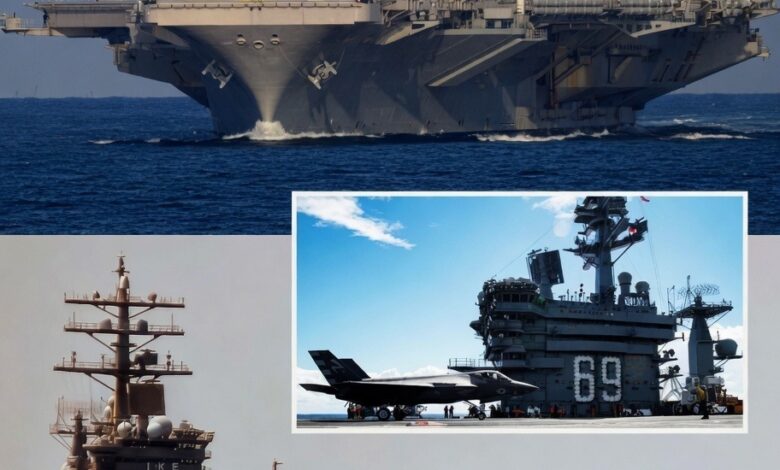
Shocking headlines have recently flooded social media platforms and online forums claiming that a Russian Su-57 stealth fighter jet successfully executed a devastating strike on a United States aircraft carrier. According to these sensational reports, the targeted American vessel was allegedly carrying an astronomical cargo of more than 700 main battle tanks. The viral articles describe a sudden, highly coordinated aerial assault that caught the heavily fortified vessel completely off guard, leaving defensive crews with absolutely zero time to react. The narrative claims that the high-impact strike resulted in catastrophic destruction, massive structural damage, and the potential loss of hundreds of military vehicles, sparking immediate panic over a massive escalation between global superpowers.
As the story continues to spread rapidly across digital networks, it has fueled intense speculation, heated debates, and urgent discussions regarding the vulnerability of modern naval defense systems. The reports paint a dramatic picture of defense analysts and international observers scrambling for answers, questioning how one of the most secure and technologically advanced military assets on earth could be compromised so easily by a single stealth fighter. The articles warn that if these claims are verified, the incident would mark a terrifying turning point in modern warfare, potentially reshaping the balance of global power and signaling a dangerous new era of rapid-strike conflict.
However, a closer examination of the facts, basic military logistics, and international defense records reveals that this viral story is entirely fabricated.
To begin with, the claim that a U.S. aircraft carrier was transporting more than 700 tanks is a physical and operational impossibility. Supercarriers, such as the Nimitz-class or the newer Gerald R. Ford-class, are designed specifically as floating airfields. Their internal structures, hangar bays, and logistics systems are optimized to house, maintain, and launch aircraft, not heavy armored land vehicles. A single American main battle tank, like the M1A2 Abrams, weighs upwards of 70 tons. Attempting to load 700 of these massive vehicles onto an aircraft carrier would equate to nearly 50,000 tons of dead weight. Not only would this exceed the practical cargo capacity of these vessels, but the physical dimensions of a carrier’s elevators, hangar decks, and internal storage spaces are completely incompatible with storing or transporting armored divisions of this scale. The United States military relies on dedicated large, medium-speed roll-on/roll-off cargo ships to transport heavy armor across oceans, never aircraft carriers.
Furthermore, there is absolutely no record, satellite evidence, or official statement from any global government or defense agency indicating that a conflict of this nature has occurred. An attack on an active United States aircraft carrier by a foreign military power would constitute an unmistakable act of war. Such an event would instantly trigger global emergency protocols, immediate military retaliation, and wall-to-wall coverage from every reputable international news organization on the planet. Instead, the only places where this dramatic scenario is being reported are niche blogs, unverified personal social media accounts, and known sensationalist websites that specialize in generating high-volume traffic through eye-catching military rumors.
Military experts and geopolitical analysts emphasize that while the Su-57 is indeed Russia’s premier twin-engine stealth fighter designed for air superiority and land-attack roles, the likelihood of it approaching a U.S. carrier strike group undetected is virtually nonexistent. Aircraft carriers never travel alone; they operate as part of a highly coordinated Carrier Strike Group. These groups are surrounded by a formidable protective screen of guided-missile cruisers, destroyers, and attack submarines equipped with advanced Aegis combat systems, early-warning radar aircraft, and active air-defense umbrellas designed to detect and neutralize incoming threats from hundreds of miles away.
The viral spread of this fabricated strike highlights a growing trend in the digital landscape: the weaponization of highly technical, emotionally charged rumors designed to exploit geopolitical anxieties. During times of heightened international tension, sensational stories involving advanced military hardware, secret weapons, or sudden devastating attacks are highly effective at capturing public attention. These narratives are often engineered to generate high click-through rates, driving advertising revenue for low-quality blogs by feeding on the natural curiosity and concern of readers who worry about the outbreak of global conflict.
As digital media consumers, encountering dramatic and unverified breaking news requires a strong dose of skepticism and careful fact-checking. Geopolitical analysts and defense experts continuously urge the public to seek out confirmation from trusted, established journalistic outlets and official defense department briefings before accepting such extreme claims as truth. In tense global environments, rumors can propagate with incredible speed, creating unnecessary panic and distorting public perception of actual global events. The definitive reality is that no US aircraft carrier has been attacked, no fleet of tanks has been lost at sea, and the balance of modern naval power remains undisturbed by this fictional stealth fighter strike.